Table of contents
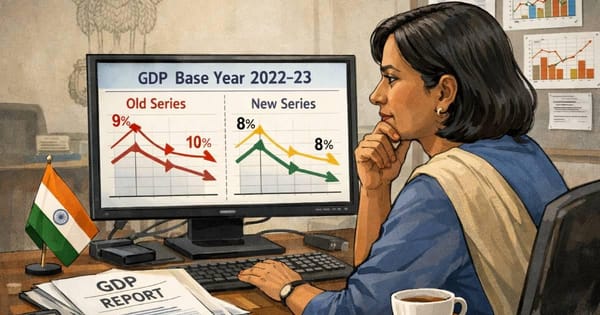
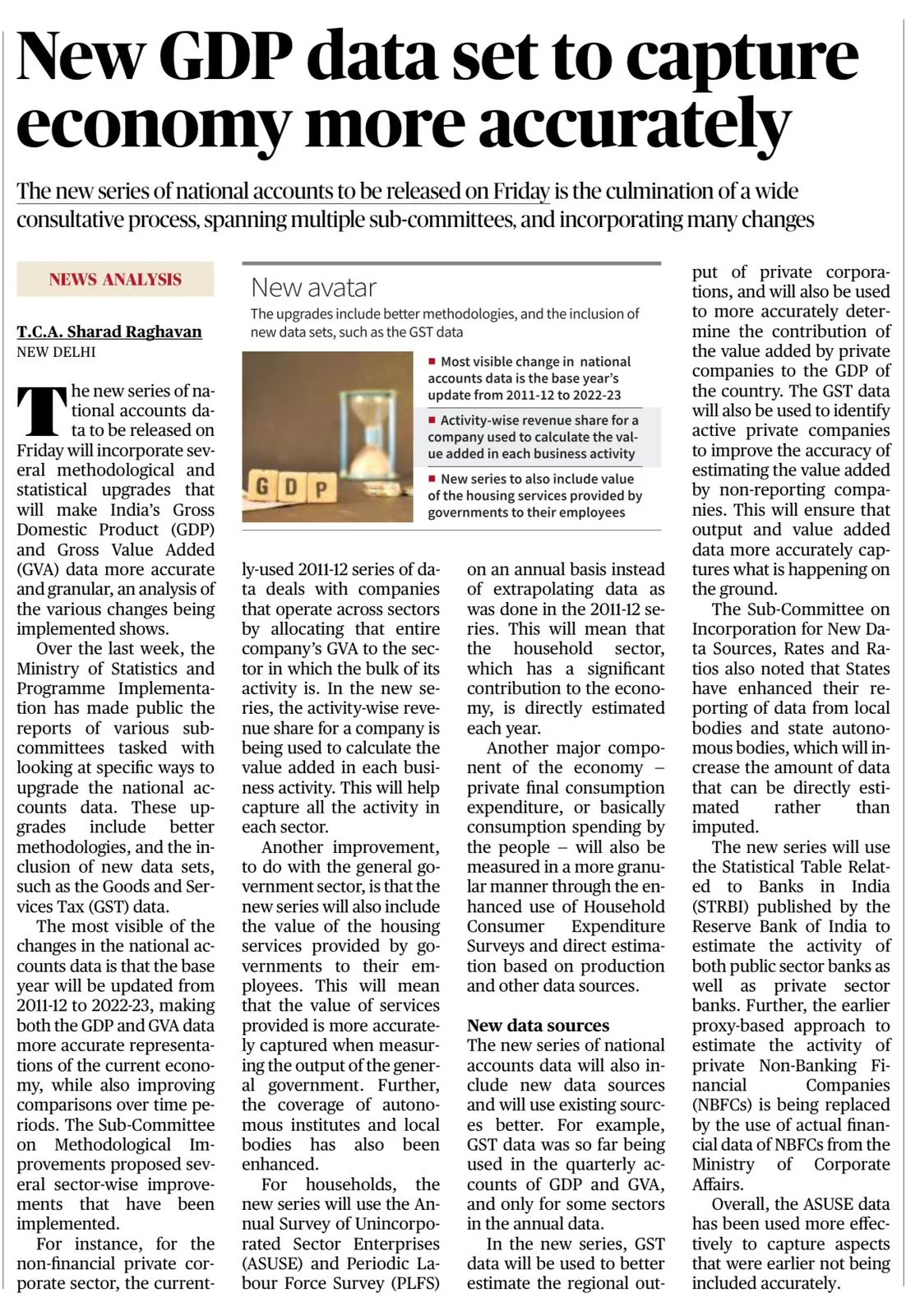
The Ministry of Statistics and Programme Implementation (MoSPI) periodically updates the methodology and base year for calculating Gross Domestic Product (GDP). The latest update introduces a "New GDP Series" with a revised base year of 2022-23, replacing the previous 2011-12 series. This exercise aims to provide a more accurate and contemporary reflection of the Indian economy.
But first,
What is Gross Domestic Product (GDP)?
Gross Domestic Product (GDP) is the total monetary value of all final goods and services produced within the geographical boundaries of a country during a specific period (usually one year).
Key Features:
- Includes only final goods and services (to avoid double counting)
- Includes production within domestic territory
- Measured for a specific time period
- Indicates the size and health of an economy
For India, GDP is estimated by the Ministry of Statistics and Programme Implementation (MoSPI).
How is GDP Calculated?
GDP can be calculated using three methods. Ideally, all three should give the same value.
(A) Production (Value Added) Method
GDP = Sum of Gross Value Added (GVA) of all sectors + Taxes − Subsidies
Used widely in India.

(B) Expenditure Method
GDP = C + I + G + (X − M)
Where:
- C = Private Final Consumption Expenditure (PFCE)
- I = Investment (Gross Capital Formation)
- G = Government Expenditure
- X − M = Net Exports
(C) Income Method
GDP = Sum of:
- Wages & salaries
- Rent
- Interest
- Profits
📌 Note: In India, GDP is primarily estimated using the production approach, cross-checked with expenditure data through Supply and Use Tables (SUTs).
Difference Between Nominal and Real GDP
| Basis | Nominal GDP | Real GDP |
|---|---|---|
| Prices Used | Current year prices | Base year prices |
| Inflation Effect | Includes inflation | Removes inflation |
| Reflects | Price + Quantity change | Only Quantity change |
| Better Indicator of Growth? | ❌ No | ✅ Yes |
Example:
If output increases 3% but prices increase 5%:
- Nominal GDP may show 8% growth
- Real GDP will show only 3% growth
Thus, Real GDP reflects actual economic growth.
What is the Significance of the Base Year in GDP Calculation?
Meaning of Base Year
The base year is the reference year whose prices are used to calculate real GDP.
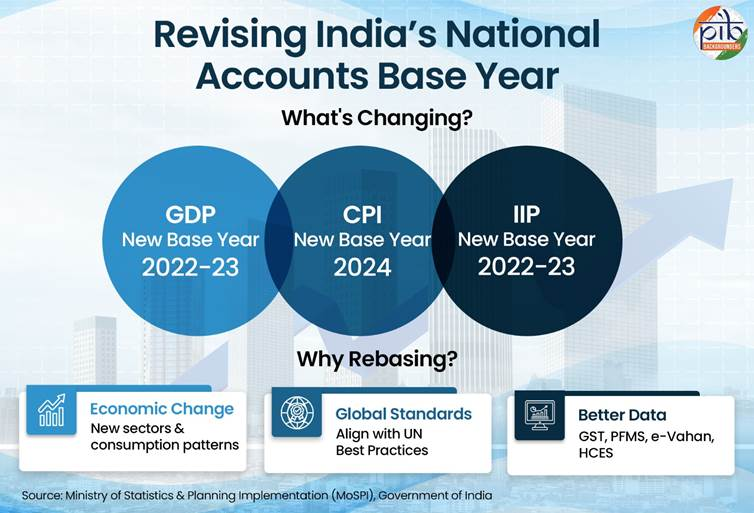
India’s new base year is 2022–23, replacing 2011–12.
Why is Base Year Important?
- Removes Inflation Distortion
Real GDP compares output using constant prices of the base year. - Reflects Structural Changes
A newer base year captures:- Rise of digital economy
- Growth in services
- Changing consumption patterns
- Improves Data Accuracy
Incorporates updated surveys like:- ASUSE
- PLFS
- GST-based data
- Ensures International Comparability
Aligns with UN’s System of National Accounts (SNA).
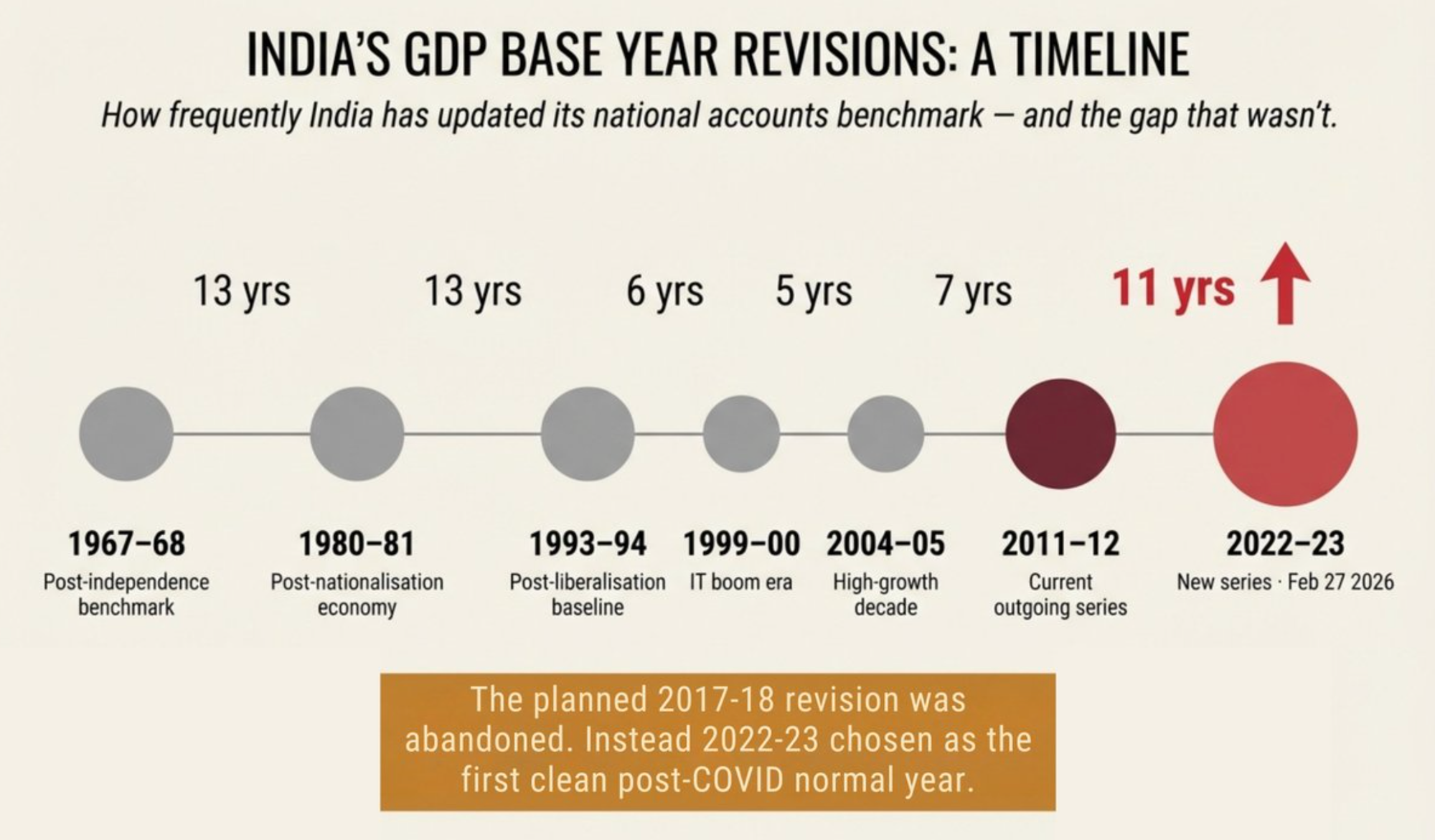
Why was 2022–23 chosen?
- Considered a relatively normal post-COVID year
- Better reflects current economic structure

New GDP Series (Base Year: 2022–23)
India’s GDP is periodically revised by the Ministry of Statistics and Programme Implementation (MoSPI) to reflect structural changes in the economy and improve statistical accuracy.
The latest revision shifts the base year from 2011–12 to 2022–23.
Why Was a New GDP Series Introduced?
- Structural Changes in the Economy
- Expansion of digital economy
- Growth of services & platform-based work
- Formalisation due to GST
- Post-COVID Normalisation
- 2022–23 considered a relatively stable year after pandemic disruptions.
- Alignment with International Standards
- Conforms to UN’s System of National Accounts (SNA).
1. Base Year Revision
- Concept: The base year is a reference point for calculating real GDP, allowing for the comparison of economic output across different periods by removing the effect of price changes (inflation).
- Explanation: The shift from 2011-12 to 2022-23 is significant.
- Why 2022-23?: This year is considered a more "normal" economic period, post-COVID-19 disruptions, providing a stable benchmark.
- Impact: A newer base year incorporates the latest structural changes in the economy, such as the growth of new industries, changes in consumption patterns, and technological advancements, which might not have been adequately captured by an older base year.
2. Updated Data Sources
- Concept: GDP estimation relies on vast amounts of data from various sectors. Using more current and granular data sources enhances accuracy.
- Explanation: The new series integrates a wider array of high-frequency and administrative data.
- Examples:
- Goods and Services Tax (GST) collections: Provides detailed insights into consumption and production across sectors.
- e-Vahan portal: Offers data on vehicle registrations, indicating activity in the transport sector.
- Public Financial Management System (PFMS): Tracks government expenditure and receipts.
- Annual Survey of Unincorporated Sector Enterprises (ASUSE): Captures economic activity in the vast informal and unorganized sectors, which are crucial for India.
- Periodic Labour Force Survey (PLFS): Provides direct yearly estimates of employment and unemployment, aiding in calculating value addition from labour.
- Examples:
- Benefit: These sources offer more timely and comprehensive information, reducing reliance on older or less frequent surveys.
3. Refined Methodologies
- Concept: The methods used to aggregate data and calculate value addition are continuously improved to align with international best practices.
- Expanded Item Basket: The number of price indicators used to deflate output has more than tripled, increasing from 180 items in the old series to approximately 600 items.
- Explanation:
- Double Deflation:
- Previous: Often used single deflation (adjusting output for price changes).
- New: Applies double deflation to sectors like manufacturing and agriculture. This involves deflating both output and intermediate consumption separately, providing a more accurate measure of real value added.
- Supply and Use Tables (SUT):
- Concept: SUTs provide a detailed picture of the supply of goods and services (from domestic production and imports) and their use (as intermediate consumption, final consumption, capital formation, and exports).
- Application: The new series aligns GDP estimation with SUTs, helping to reduce discrepancies between GDP calculated from the production side and the expenditure side. This ensures consistency and improves data quality.
- Private Final Consumption Expenditure (PFCE) Estimation:
- Improvement: PFCE, a major component of GDP, is now estimated using a combination of direct production data, administrative data, and a commodity flow approach. This offers a more robust and granular estimation of household consumption.
- Double Deflation:
4. Capturing the Gig and Informal Economy
- Concept: Modern economies are seeing a rise in platform-based work and informal sector contributions, which are often challenging to measure.
- Explanation: The new series makes dedicated efforts to better capture:
- Digital and Platform Economy: Activities related to online services, e-commerce, and app-based services.
- Gig Economy: Freelance, temporary, or flexible jobs performed by independent contractors.
- Informal Sector: Including activities of hired domestic workers and other unorganized economic units, which contribute significantly to India's economy.
- Benefit: This ensures a more inclusive measure of economic activity, reflecting the evolving nature of work and production.
5. Implications for Economic Indicators
- Revised Growth Rates:
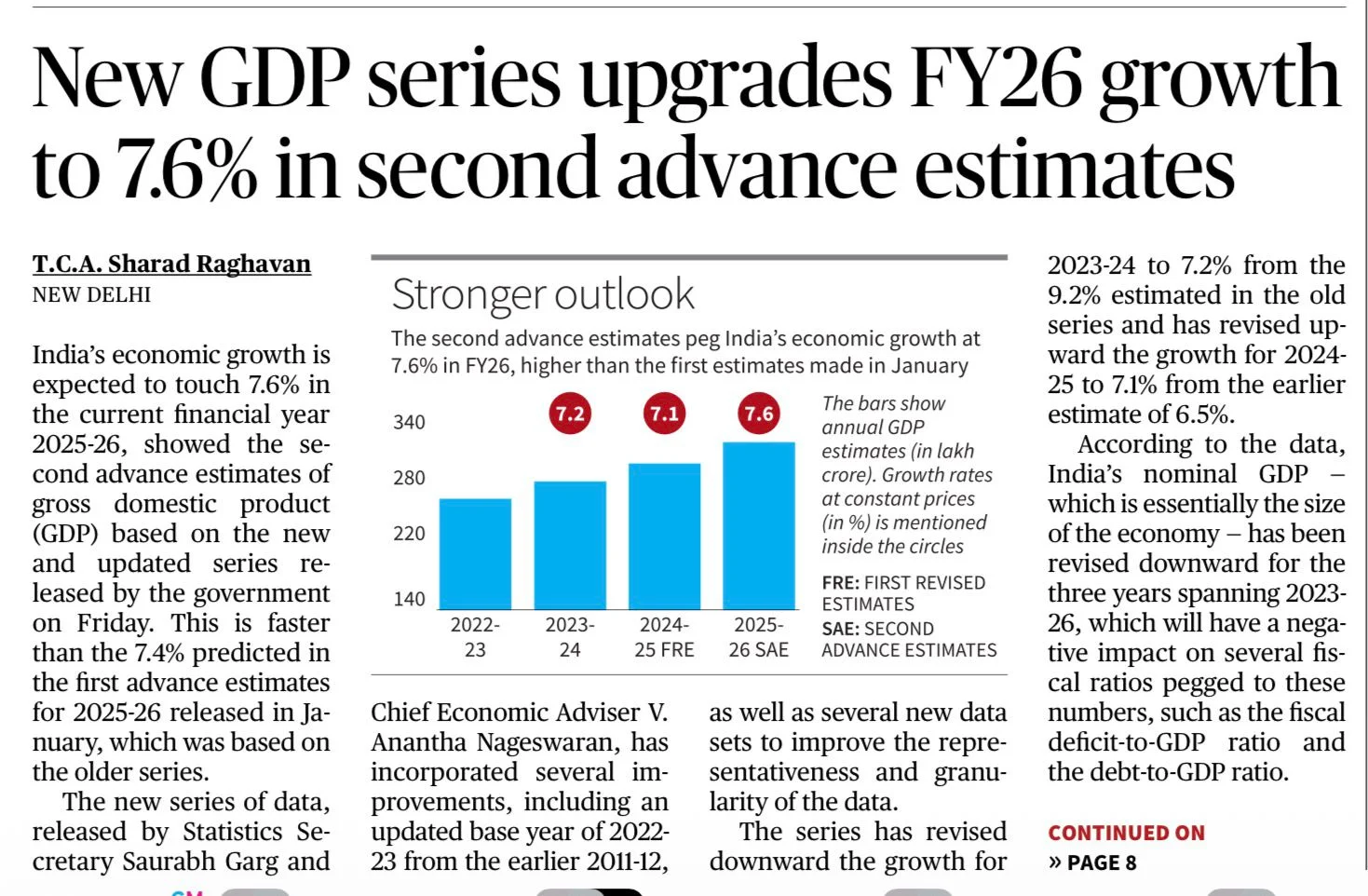
- The new series often leads to revisions in historical and projected GDP growth rates. For instance, the FY2023-24 real GDP growth was revised downwards.
- FY 2023–24 real GDP growth revised downward.
- FY 2025–26 projected growth around 7.6%.
- Why?: The updated methodologies and data sources might present a different picture of economic expansion compared to the previous series.
- The new series often leads to revisions in historical and projected GDP growth rates. For instance, the FY2023-24 real GDP growth was revised downwards.
- Nominal GDP Size:
- The nominal GDP (GDP at current prices) can also be revised. The new series has shown a downward revision in nominal GDP for recent years.
- Recent years’ nominal GDP estimated 3–4% lower.
- FY 2025–26 nominal GDP ≈ ₹345.47 lakh crore (as per new series).
- Impact: A smaller nominal GDP base has significant implications for various economic ratios.
- The nominal GDP (GDP at current prices) can also be revised. The new series has shown a downward revision in nominal GDP for recent years.
- Fiscal Ratios: Since fiscal indicators use GDP as denominator:
- Debt-to-GDP Ratio: If nominal GDP is revised downwards, the debt-to-GDP ratio (a key indicator of fiscal health) will increase, even if the absolute debt remains the same.
- Debt-to-GDP ratio ↑
- Fiscal Deficit-to-GDP Ratio: Similarly, the fiscal deficit as a percentage of GDP will also increase, making fiscal targets harder to achieve.
- Fiscal deficit-to-GDP ratio ↑
- Significance: These changes impact government policy decisions and international ratings.
- Debt-to-GDP Ratio: If nominal GDP is revised downwards, the debt-to-GDP ratio (a key indicator of fiscal health) will increase, even if the absolute debt remains the same.
- Even if absolute borrowing remains unchanged. This has implications for:
- Fiscal policy
- Credit ratings
- Budget targets
6. Back Series Data
- Concept: To maintain comparability, historical GDP data (the "back series") needs to be recalculated using the new methodology.
- Explanation: MoSPI will release recalculated back series data, allowing economists and policymakers to analyze long-term economic trends consistently with the new base year and methodology. This is crucial for understanding the trajectory of the economy over time.
Conclusion
The introduction of the new GDP series with a 2022-23 base year is a crucial step towards enhancing the accuracy and relevance of India's economic statistics. It provides a more robust framework for policymakers, researchers, and the public to understand the true state and dynamics of the Indian economy. For UPSC aspirants, a clear understanding of these changes, their underlying concepts, and their implications is essential for both Prelims and Mains examinations.
Previous Post