
Topic: Governance and Social Justice Government Policies and Interventions for Development in various sectors and Issues arising out of their Design and Implementation. Development Processes and the Development Industry — the Role of NGOs, SHGs, various groups and associations, donors, charities, institutional and other stakeholders.
Q1. Critically evaluate the role and functioning of the NITI Aayog in shaping India's development trajectory. Discuss how it differs from its predecessor, the Planning Commission. (15 Marks)
Model Structure
Introduction
- The NITI (National Institution for Transforming India) Aayog was established in 2015 to replace the Planning Commission, marking a significant institutional shift in the economic governance of India. (Historical Context)
Main Body
Role and Functioning of NITI Aayog
- Policy Formulation and Evaluation: NITI Aayog provides strategic and technical advice to the central and state governments, fostering an evidence-based policy-making approach. (For e.g. NITI Aayog's "Strategy for New India @ 75")
- Fostering Cooperative Federalism: NITI Aayog is a collaborative platform fostering cooperative federalism. It ensures a better Centre-state collaboration and integration of national and regional development agendas.
- Promoting Innovation: Through initiatives like the Atal Innovation Mission, NITI Aayog encourages a culture of innovation and entrepreneurship.
- Monitoring and Evaluation: It oversees implementing programmes and initiatives, providing an accountability framework. For instance, it has been tasked with monitoring the progress of the Sustainable Development Goals (SDGs) in India.
Difference between Niti Aayog and Planning Commission
Conclusion
Therefore, while the Planning Commission was a product of the planned economy era, NITI Aayog reflects the needs of a modern, dynamic, and market-oriented economy.
Q2. Examine the significance of Non-Governmental Organizations (NGOs) in India's developmental journey. In your opinion, are the current legal and regulatory systems sufficient to ensure the efficient functioning of NGOs? (15 Marks)
Model Structure
Introduction
- A non-governmental organization (NGO) is a group that functions independently of any government. It is usually non-profit.
- Non-Governmental Organizations (NGOs) play an integral role in India's development trajectory. Acting as critical drivers of civil society, NGOs not only facilitate service delivery but also foster innovation, voice underrepresented groups, and shape policy discourse.
Main Body
Their role becomes critical, especially in areas where government mechanisms may not reach efficiently.
Significance of NGOs in India’s developmental journey
- Service Delivery: NGOs often fill gaps in public service delivery, especially in inaccessible and underserved regions. For example, organizations like Goonj have made noteworthy contributions to disaster relief efforts, filling in gaps left by official relief measures
- Representation and Advocacy: NGOs serve as a voice for marginalized and vulnerable sections of society, advocating for their rights and welfare. For instance, PRADAN has been instrumental in empowering rural women through self-help groups.
- Policy Influence: Many NGOs actively contribute to policy discourse and reforms.
- Innovation: NGOs have pioneered innovative development models. The Akshaya Patra Foundation’s mid-day meal program exemplifies an NGO initiative scaling up to national importance.
Current Legal and Regulatory Systems for NGOsThe present legal and regulatory mechanisms present a mixed picture. While they do provide a structured framework for NGO operations, they also pose some stringent constraints.
- Regulatory Acts: The functioning of NGOs in India is governed by various acts like the Societies Registration Act, 1860; the Indian Trusts Act, 1882; and the Companies Act, 2013 (Section 8).
- FCRA Regulations: The Foreign Contribution (Regulation) Act, 2010, regulates the acceptance and utilization of foreign contributions. The 2020 amendment to FCRA has been viewed by some as restrictive, potentially constraining the NGO sector.
- Accountability Mechanisms: Mechanisms like the Darpan portal of NITI Aayog, and the NGO Darpan portal managed by the Ministry of Electronics and IT aim to ensure transparency and accountability.
Conclusion
To enhance the efficiency of NGOs, it is paramount to ensure a balance between accountability and autonomy.
A conducive regulatory environment characterized by ease of compliance, transparency, and proportionate controls on malpractices, can truly leverage the potential of NGOs in India's socio-economic development.
Q3. Briefly discussing the historical development of Self Help Groups in India, enumerate their advantages and issues involved. (15 Marks)
Model Structure
Introduction
- Self Help Groups (SHG) is an informal association of people with similar interests and end goals who come together by pooling their resources to improve their living conditions.
Main Body
- The main functions of SHGs are to plan for additional income, persuade members to thrift and save, and become financially viable so that banking services are easy to avail. The development of SHGs has gone through phases like-
- Origin can be traced back to 1952 when the Textile Labour Association of Ahmedabad formed its women wing to provide basic skills like weaving, knitting etc.
- Formal beginnings started in 1972 with the setting up of the Self-Employed Women’s Association. A pivotal role was played by Ela Bhatt by organizing poor women working in weaving, food industry etc to enhance their income.
- Organised beginnings can be traced back to NABARD’s SHG Bank Linkage Project of 1992 which is the world's largest microfinance project.
- Swarnajayanti Gram Swarozgar Yojana was launched in 1999 which became National Rural Livelihoods Mission in 2011 to promote self employment in rural areas.
- The idea of SHG is ever evolving due to improvements taking place with time and thus it is important to understand its advantages like-
- Bringing marginalized and weaker sections into the mainstream, so that they can be active participants in the development process.
- SHGs mostly cater to the needs of women and thus it brings gender equality.
- Financial inclusion is an important aspect as most of the lending is to the poor and marginalized section and taking loans become easy due to better collaterals.
- Government schemes become more effective as SHGs become a channel to implement and avail the benefits of the schemes.
- Better social indicators like health, family planning and education, and it also prevents distress migration.
- Alternative sources of livelihood protects them against external shocks and gives them more bargaining power thus giving a boost to the economy.
- But there are some issues which prevent SHGs from realizing their full potential. Some of them are-
- Members of SHGs, especially those in decision making positions do not necessarily come from poor backgrounds.
- There is very little skill development which means that the future prospects of these members are not good. Value addition is poor and skills are primitive which makes their earnings subsistence in perpetuity.
- Patriarchy prevents women from participating and only few rural pockets have seen actual realization of its potential.
- Presence of only 1.5 lakh bank branches show lopsided presence in about 6 lakh villages thus affecting accessibility.
Conclusion
There is a need to strengthen SHGs by rapid expansion of financial infrastructure, extending aid to urban areas, and making the government play the role of facilitator.
Q4. ‘People's plan campaign’ was launched to prepare the Gram Panchayat Development Plan (GPDP). Highlight the importance of decentralised planning generally and GPDP specifically. (15 Marks)
Model structure
Introduction
- People’s plan campaign aims to prepare Gram Panchayat Development Plan (GPDP) in Gram Sabha meetings in 29 areas, by ensuring maximum participation of vulnerable sections of society.
Main body
- It aims to improve the role of elected representatives of panchayats and women SHGs to ensure holistic planning.
GPDP formulation process-
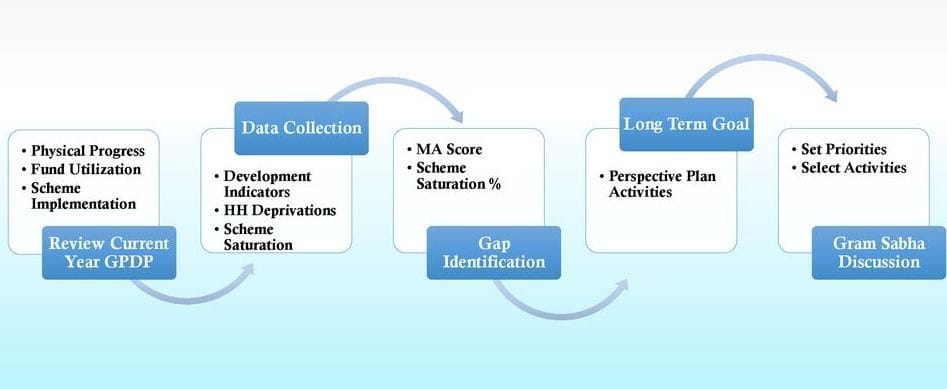
- Importance of decentralised planning is-
- More accountable local government to citizens.
- Enhanced resource mobilisation and their timely availability.
- Improved social contract between locals and representatives.
- Responsive governance with feedback and timely actions.
- Promoting economy and efficiency by proper utilisation of resources.
- Specifically, GPDP is significant because-
- Article 243G has provisions for Gram Sabha under which they will prepare and implement GPDP. It will provide a vision with clear goals and action plans.
- Involves participation and convergence of all related schemes.
- All 29 subjects of the 11th schedule are included as the base of planning.
- Will play a greater role in the implementation of flagship schemes.
- Gram Sabha dashboard to ensure maximum participation through the Standing Committee and Gram Sabha meetings.
- Challenges in GPDP formulation include-
- Insufficient funding. Even with a good plan, funding constraints defeat the purpose.
- Lack of trained staff to prepare holistic plans.
- Corruption and leakages causing misuse of funds.
- Inflexibility in spending of funds which is highly dictated by politics.
- Coordination issues among various departments.
Conclusion
India’s decentralisation exercise is one of the largest in the world with a robust constitutional and legal structure for its enforcement. Panchayats must be seen as institutions of self-governance to realise Gandhiji’s dream of ‘Gram Swaraj’.
Q5. More than ten years after getting constitutional status by the 97th Amendment Act, co-operatives are yet to achieve their full potential. Enumerate how co-operatives can be a game-changer for their members and why they haven’t achieved their desired potential yet. (15 Marks)
Model Structure
Introduction
- Cooperatives are voluntary associations of individuals with common needs and interests who join hands for common economic goals. The 97th Amendment made it a fundamental right under Article 19(1) (c) and a directive under Article 43B to form co-operatives.
Main body
- Members of co-operatives have common economic and social needs. Potential of cooperatives include-
- A lot of distress-sale, especially that of agricultural commodities, can be avoided which gives more bargaining power to farmers to get a better return for their produce.
- Diversification of risks and profits due to many stakeholders or participants.
- It also helps to easily start any venture. Cooperatives have succeeded in the dairy, sugar, fertiliser, and rubber sector and can be replicated in other sectors also.
- Equal voting rights mean member contribution and shared responsibility, with limited liability..
- Better prospects for women and other marginalised groups with respect to jobs. This prevents distress migration
- Issues in working of cooperatives-
- Less coverage due to small size and fewer members join it due to centralisation, resulting in undemocratic decision making.
- Manipulation due to money and muscle power in elections. They have become dens of corruption and many are controlled by powerful politicians. Eg- Sugar cooperatives of Maharashtra.
- Overdependence on the government for funds and lack of quality management hinder growth.
- Poor infrastructure and lack of skilled manpower affect the efficient functioning of co-operatives.
- Awareness issues as people are not informed about its benefits.
- This can be overcome by steps like-
- Better branding as in the case of AMUL. This will promote standardization and quality control thus ensuring better returns.
- Overregulation must pave the way to more autonomy and development based on market forces rather than politics.
- Transparency in management along with training of personnel.
- Availability of funds and loaning can be made easy for a better investment.
Conclusion
Local level co-operatives must work to cater to the primary sector and needs of the rural majority whereas at the state and national levels they must imbibe good practices from the private sector to compete better.
Previous Post