Table of contents
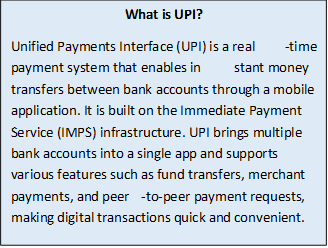
Launched in April 2016 by the National Payments Corporation of India (NPCI) under the regulatory oversight of the Reserve Bank of India (RBI), the Unified Payments Interface (UPI) began with just 21 participating banks. According to official data from the Press Information Bureau (PIB), UPI has evolved into the world's largest real-time payment system, processing 49% of global real-time payment volumes and accounting for 85% of all digital payment transactions in India.
How UPI Has Changed Everyday Life
UPI has made digital payments part of daily life in India. It brings ease, speed, and safety to even the smallest transactions. Here is how it impacts ordinary people:
- Money Anytime, Anywhere: No need to stand in queues or wait for bank hours. UPI lets people send or receive money instantly, 24x7, right from their mobile phones.
- One App for All Accounts: Managing money is simpler. People can link all their bank accounts in one app instead of juggling multiple platforms.
- Safe and Quick Payments: With secure two-step authentication, payments happen in seconds without compromising safety.
- Privacy First: Users no longer share sensitive bank details. A simple UPI ID is enough, reducing risks for everyone.
- QR Code Convenience: Paying with UPI is as simple as scanning a QR code. This helps speed up transactions at shops and service points.
- No More Cash-On-Delivery Hassles: Online shopping becomes easier as UPI replaces the need to keep exact change for deliveries.
- Payments for Everything: People can now pay bills, donate, or recharge phones without stepping out of their homes.
- Help Is Just a Tap Away: Any issue with a payment can be reported directly in the app, making grievance redressal easy.
The Decadal Surge in Numbers
| Metric | FY 2016–17 (Launch Era) | FY 2025–26 (Decade Mark) | Decadal Growth |
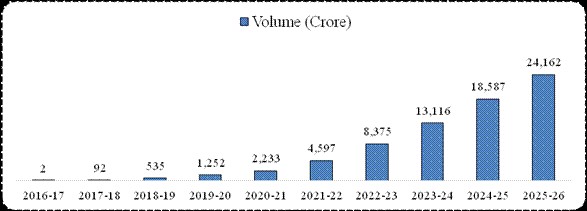
| Annual Volume | 2 Crore transactions | 24,161.69 Crore transactions | ~12,000-fold surge |
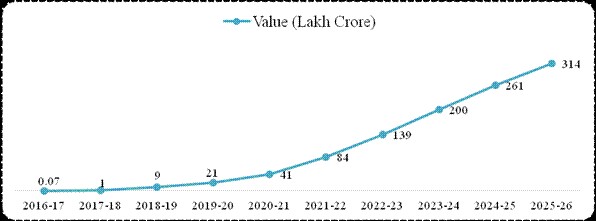
| Annual Value | ₹0.07 Lakh Crore | ₹314.23 Lakh Crore | ~4,000-fold surge |
| Live Onboarded Banks | 21 Banks | 703+ Banks | ~33-fold expansion |
| Daily Average Volume | ~0.01 Crore | 66 Crore transactions | Massive daily scale |
| User Base | Pilot groups | 55.49+ Crore individuals | Deep penetration |
| Merchant Ecosystem | Selected vendors | 6.5+ Crore merchants | Universal adoption |
Annual Transaction Volume Growth (2016-2025)
Annual Transaction Value Growth (2016-2025)
Core Architectural & Financial Concepts
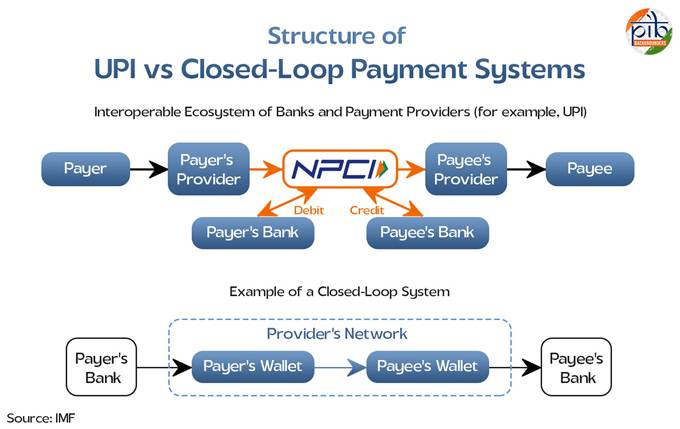
- Unified Payments Interface (UPI): An open-architecture, real-time payment system that enables instant, 24/7 inter-bank transfers using a unique Virtual Payment Address (VPA) or mobile number, eliminating the need to expose bank account details during Peer-to-Peer (P2P) or Person-to-Merchant (P2M) transfers.
- NPCI (National Payments Corporation of India): An initiative of the RBI and Indian Banks' Association (IBA) established to create robust payment and settlement infrastructure in India.
- Merchant Discount Rate (MDR): The processing fee charged to merchants by acquiring banks and third-party app providers (TSPs) for digital transactions. In 2019, India implemented a 0% MDR mandate for UPI to accelerate vendor adoption.
- JAM Trinity (Jan Dhan–Aadhaar–Mobile): The foundational digital public infrastructure (DPI) enabling identity verification (Aadhaar), direct financial access (Jan Dhan), and low-cost data connectivity that enabled friction-free UPI scaling.
Primary Drivers of Adoption
- Zero-Cost Merchant Onboarding: Removing MDR fees allowed small vendor setups to accept QR code payments without transaction overheads.
- Interoperability & Simplicity: A single smartphone application allows consumers to link multiple bank accounts for instant settlements via QR code scanning.
- Drastic Fall in Data Costs: Mobile internet data prices dropped significantly over the decade, paired with high-speed broadband expansion across rural Gram Panchayats.
Current Structural Challenges & The Road Ahead
The current policy framework for UPI combines a zero-fee structure for consumers and merchants with targeted regulatory rules to encourage adoption while maintaining system stability. Expanding on the ecosystem's structural challenges and future outlook shows how UPI is transitioning from a high-volume payments pipe into a multi-product financial rail.
Current UPI Policy Framework
- Zero-MDR Mandate: The government mandates a 0% Merchant Discount Rate (MDR) for standard bank-to-bank UPI and RuPay debit card transactions. Merchants incur no transaction charges for accepting payments.
- Government Subsidies: The Centre provides an annual budget allocation to compensate banks and Payment Service Providers (PSPs) for processing small-value merchant payments (up to ₹2,000).
- Selective Commercial Charges:
- Prepaid Payment Instruments (PPI/Wallets): An interchange fee of up to 1.1% applies to merchant transactions above ₹2,000 made via digital wallets.
- Credit on UPI: RuPay credit card links and pre-approved credit lines carry standard MDR (~1.1% to 2.0%) to compensate issuing banks.
- Transaction Limits: Default daily limit is set at ₹1 lakh, with higher limits of ₹5 lakh available for specific categories such as tax payments, healthcare, education, capital markets, and IPO subscriptions.
Current Structural Challenges
- Financial Sustainability & Infrastructure Costs: Operating the UPI network requires approximately ₹20,000 crore annually in backend IT infrastructure, cybersecurity, and server capacity. Because zero MDR applies to standard transfers, fintechs and acquiring banks bear significant unrecovered operational costs. Industry bodies are requesting a 0.3%–0.6% MDR on transactions over ₹2,000—which account for just 4% of volume but 68% of total value.
- Duopoly & Market Concentration: Third-Party App Providers (TPAPs) PhonePe and Google Pay hold over 83% of the market by transaction value. NPCI’s directive to cap any single player's market share at 30% has been deferred to December 31, 2026 to avoid service disruptions or artificial transaction declines for users.
- Core Banking System (CBS) Load: Processing 600+ million daily transactions strains traditional bank infrastructure. NPCI has implemented operational guidelines—capping daily balance checks and shifting automated recurring payments (AutoPay) to off-peak hours—to prevent peak-time server failures.
UPI on the World Stage
What began as a domestic payments innovation has today evolved into a global benchmark in digital payments.
As of 2024, India’s Unified Payments Interface (UPI) accounts for nearly 49% of the world’s real-time payment transaction volume, a milestone recognised by the International Monetary Fund (IMF) in its report in June 2025.
With over 66 crore transactions processed daily, UPI has surpassed global payment networks, reinforcing India’s position as the world leader in instant, secure, and inclusive digital payments.
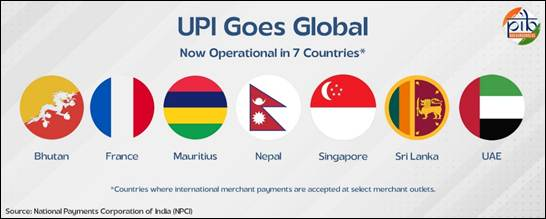
UAE | Operational, accepted at major merchant points; used by Indian diaspora |
Singapore | Operational, linked with Singapore's PayNow for cross-border transfers |
France | Operational, expanding Indian tourist payment acceptance |
Bhutan | Operational, NPCI-enabled real-time cross-border payments |
Nepal | Operational, accepted across the nation |
Sri Lanka | Operational, Indian visitor and diaspora payments |
Mauritius | Operational, integrated with local payment infrastructure |
Qatar | Operational. |
The Road Ahead
| Strategic Pillar | Core Focus & Implementation |
| Credit Integration | Expanding Credit on UPI by linking pre-approved bank credit lines and RuPay credit cards to UPI handles, unlocking small-ticket credit at local merchants without physical POS terminals. |
| Global Footprint (NIPL) | Scaling international interoperability across 9+ countries (including UAE, Singapore, France, Mauritius, Sri Lanka, and Nepal) and connecting with foreign real-time networks like Singapore's PayNow to lower cross-border remittance costs. |
| Offline & Feature Phone Inclusion | Increasing limits on UPI Lite (on-device wallet for quick micro-payments) and UPI 123Pay (IVR/feature phone payments) to drive penetration in rural and semi-urban regions. |
| AI & Delegated Payments | Rolling out UPI Circle (delegated payment access for family members) and Conversational Voice Payments integrated with AI assistants to simplify user onboarding. |