
Topic: Modern Indian History
Q1. British land revenue policies were different for different regions. Discuss these policies and their impact on Indian agriculture and economy. (15 marks)
Model Structure
Introduction
- Britishers in India extracted land revenue directly or through intermediaries in an indirect way. This was done by different land revenue policies to collect maximum possible land revenue from peasants.
Main Body
The British were dependent upon Indian officials at a lower level to collect land revenue. For this, depending upon local conditions, they introduced three types of settlements.
- Ryotwari settlement was another system for southern India in the princely states of Madras, Bombay and Assam. The cultivator was recognized as the actual owner of land but only if timely payment of land revenue was done. Unlike permanent settlement, this was revised periodically after 20 to 30 years.
- Third was the Mahalwari system for the Gangetic valley, Central India, Punjab and the North–west provinces. Villages were called mahal and were units of settlement. Agreement was done with village heads who collectively represented villages with periodic revision of land revenue.
Permanent settlement of Bengal, Bihar and other eastern areas saw state demand getting fixed at 90% of the rental. This was done for an infinite period and was unalterable forever. Zamindars got ownership rights which were transferable and hereditary.
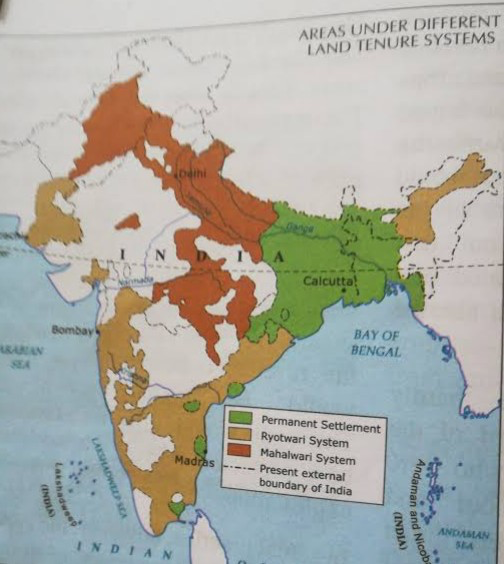
These settlements were exploitative. Impact on Indian Agriculture:
- Decreasing investments in land and stagnation of agriculture because peasants were in the fear of getting evicted even after investing.
- Land was commercialized due to high revenue demands which led to ousting of peasants who couldn’t pay the revenue or auctions of many estates. Only those peasants survived who could pay ever increasing revenue demands.
- Agricultural productivity decreased because there was no incentive for zamindars to invest in agriculture because they got fixed revenue.
- High revenue demands meant peasants had to take credit from moneylenders which resulted in rural indebtedness.
- Major part of agriculture revenue was sent to Britain and destruction of other rural industries meant economic collapse of rural India.
- Numerous famines and epidemics resulted in starvation and deaths which impacted agriculture from socio economic perspective.
Conclusion
- Land revenue policies by the British were very exploitative in nature and were devised to serve their own interests and that of a few zamindars. It is important to understand this so that exploitation of small farmers and sharecroppers is minimized today.
Q2. In many ways, Lord Dalhousie was the founder of modern India. Elaborate. (10 Marks)
Model Structure
Introduction: Lord Dalhousie was the Governor-General of India between 1848-1856.
Main Body:
Lord Dalhousie- Founder of modern India:
Administration:
- For the newly acquired territories, he introduced the centralised control called “Non-Regulation System”.
- Under military reforms Dalhousie shifted the headquarters of Bengal Artillery from Calcutta to Meerut.
- Simla was made the permanent headquarters of the army.
Communication
- Introduction railways in India → started a new economic era.
- The first railway line connecting Bombay with Thane started in 1853. Railway lines connecting from Calcutta to the Raniganj coal-fields were opened in 1854 .
- He started the “guarantee system” by which the railway companies were guaranteed a minimum interest of five percent on their investment.
Telegraph
- Telegraph brought commendable changes in the communication system.
Postal Reform
- The foundation of the modern postal system was laid down by him. A new Post Office Act was passed in 1854.
- Consequently, irrespective of the distance, a uniform rate of half an anna per post card was charged throughout India.
- Postage stamps were introduced .
Education
- Under him the educational despatch of Sir Charles Wood (1854) was considered the “Intellectual Charter of India”.
- It provided an outline for the comprehensive education at primary, secondary and collegiate levels.
- Dalhousie fully accepted it and took steps to carry out the new scheme.
- The Universities of Calcutta, Bombay and Madras were established in 1857.
Public Works Department
- Dalhousie created a separate Public Works Department and allocated more funds for cutting canals and roads.
- The Upper Ganges Canal was completed in 1854.
- By modernizing the Public Works Department he laid the foundations of the engineering service in India.
However the outbreak of Mutiny in 1857 led to a severe criticism of his policy of annexation.
Conclusion
- There is no doubt that Dalhousie was an able administrator and visionary. He increased the extent of British India and consolidated it. He inaugurated an era of progress on many sides.
- He was the father of Railways and Telegraphs. He introduced the process of modernization of India. Hence, he is hailed as “the maker of modern India”.
Additional Information
Other Highlights of Dalhousie’s Tenure -
- Policy of Annexation: His aims for expanding the Company’s territories were administrative, imperial, commercial and financial.His territorial acquisition transformed the map of India.His great annexations include the Punjab, Lower Burma, most of the Central Provinces and Oudh.
- Doctrine of Lapse - Dalhousie took advantage through this policy to acquire territory by peaceful means. And annexed Satara, Jhansi and Nagpur were substantial to the British. But he was blamed for using the Doctrine of Lapse as an instrument in pursuing his policy of annexation. After the Mutiny of 1857, the doctrine of lapse was withdrawn.

Q3. With the declining Mughal power, Marathas rise to supremacy was like a writing on the wall. Enumerate the reasons behind this, and also discuss why they failed in their quest to establish pan India supremacy. (15 marks)
Model Structure
Introduction
- The 18th century witnessed decline of Mughal empire and subsequent rise of many regional powers of which Maratha empire was the strongest and controlled large swathes of land.
Main body
- Marathas were a formidable force in Western India and quickly controlled Deccan, Central India and parts of North India. Many reasons can be cited for quality of their power, like-
- The terrain, mountains and dense forests made them adopt guerilla tactics and they also made forts on mountains which were easy to defend due to strategic advantage.
- Though they suffered heavy losses in the third battle of Panipat, they quickly regrouped and achieved a position of power. This was possible due to confederacy type of political arrangement.
- Before the rise of Marathas, these leaders were employed in the army of Deccan states of Bijapur, Bidar, Ahmednagar etc which made them skillful and tactful.
- Bhakti movement of Maharashtra brought a sense of unity among the otherwise fragmented confederacy.
- They introduced taxes like Chauth and Sardeshmukhi and also had robust political arrangements of Ashtapradhan which helped manage affairs in a better way.
- But there were some weaklings which didn’t make this dream of a pan India empire into a reality like-
- Flawed nature of Maratha state- formed on the basis of religion-national movement thus the cohesion was inorganic and due to lack of technology, the military was not advanced.
- Incompetent leadership as later Maratha rulers like Bajirao II and Jaswantrao Holkar were despotic and selfish.
- Superior English setup with better diplomacy and spy system. This was later evident in the Battle of Plassey which was a turning point in colonization of India.
- Unstable economic policy didn’t evolve with time, and lack of foreign trade and industries put the empire on a back foot.
- Political setup was also loose because chiefs like Bhonsle and Holkar carved out their own state and didn’t follow central orders.
- Renaissance in Europe further gave a progressive tinge to Britishers as they were more focused on scientific developments, industrial breakthroughs and colonization.
Conclusion
- Thus it can be said that though the Marathas stood the test of Mughals and Abdalis in the third battle of Panipat, they had to bow down before the British due to their own flaws and the superior methods of colonizers.
Q4. Social reform movements of the 19th century were a distinguishing feature of the Indian freedom struggle. Critically analyse various aspects of these movements. (10 marks)
Model structure
Introduction
- The period of social reform movements can also be said to be a period of reawakening or ‘renaissance’ which focused on areas like position of women, religious superstitions, caste problem, western culture and child marriage. OR
- The 19th-century social reform movements in India were a reaction to the oppressive social norms and customs that were deeply rooted in traditional Indian society.
- Caste-based discrimination, child marriage, sati (widow immolation), purdah (seclusion of women), and untouchability were some of the regressive practices that the reformers sought to address.
Main Body
- These reform movements were fuelled by middle class intelligentsia who used medical opinion, religious tenets, vedic scriptures and values of humanity and brotherhood to bring in reforms. These reforms had positive aspects like
- Worship and other religious practices were made a personal affair which gave the marginalized sections much needed self respect.
- It created a social atmosphere for modernization and encouraged a secular way of thinking.
- National consciousness was fostered and it brought people from different sections together (unity).
- In earlier times, India was secluded from the outer world and there was minimal exchange of ideas. This renaissance period ended cultural and intellectual isolation.
- They contributed to the abolition of sati, the promotion of widow remarriage, the establishment of women's education, the recognition of Dalit rights, and the questioning of caste-based prejudices.
- These reforms laid the foundation for a more progressive and inclusive society.
- Even though the idea and thought process was noble, there were some unintended negative consequences like
- Some leaders of movements themselves went against the mandate. Like Keshub Chandra Sen was against child marriage but himself married his daughter to a young prince who was not of a legally marriageable.
- Narrow social base because majority movements were led by upper caste individuals which caused distrust among masses when it came to supporting the movements.
- Religious divides were visible and Hindu reformers glorified ancient India while Muslim reformers praised the medieval period.
- Secular and moral aspects were given less stress and religious aspects of culture were given more attention.
Conclusion
- Social reforms are an ongoing process because of changing times and evolving ideas. Many reforms mentioned above are still to take shape fully. It is the duty of civil society, government and individuals to take these reforms forward to give a better and dignified life to affected groups. OR
- The social reform movements of the 19th century were a pivotal aspect of the Indian freedom struggle, representing the evolving consciousness of Indian society. While these movements achieved significant milestones, the fight for social justice remains an ongoing endeavor in modern India.
Q5. Examine the factors contributing to the frequent uprisings against British rule for a century before 1857. Furthermore, highlight the distinguishing characteristics of the 1857 revolt compared to earlier rebellions. (15 Marks)
Model Structure
- Introduction(1): While various foreign imperial powers ruled certain regions of India with little or no resistance from the people, it was the British who faced a nationwide revolt in different capacities. The extensive and prolonged nature of British rule affected all sections of society, leaving little opportunity for revolt.
- Introduction(2): British dominance started from the 1757 Battle of Plassey and was legitimised by the 1764 Buxar Battle. They deployed multiple methods of domination ranging from expansionist policies, land revenue system, industrial and religious policies.
Main Body:
Reasons for frequent revolts:
- Economic issues: oppressive policies like Zamindari, Rayatwari, Mahalwari, and Free Trade policy drained the wealth of farmers and artisans.
- E.g. Pabna uprising and Indigo revolts.
- Political conquest: Starting from Double government in Bengal, ring-fencing, subsidiary alliance, and doctrine of lapse.
- This brought them into conflict with natives regularly, thus, revolts and wars like Carnatic wars, Maratha wars, and Punjab rebellion were recurring.
- Religious policy: British were also involved in the promotion of Christianity.
- They brought changes like preventing turban in the armed forces, forcing them to cross the sea, and also mixing bone dust.
- The Pagalpanti movement, Wahhabism, and Shuddhi movement were some outbursts by the people.
- Changing administration: Multiple changes like the Regulation Act, Charter Act, General Enlistment Act, etc., were announced.
- Berhampur and Barakpur were the results of these changing policies.
All the reasons culminated in the 1857 revolt, and the British might be challenged by natives at the pan-Indian level.
Differentiating factors of the 1857 revolt from its predecessors:
- Pan India level: It spread across the length and breadth of the land. From Rani Lamiae in the north to Rani Chennamma in the south. It was more inclusive and spread widely.
- Unity among masses: Hindu-Muslim unity was widely observed, earlier movements had a narrow base and less cooperation between Hindu and Muslim communities.
- The acceptance of Mohamed Shah Zafar by all groups as emperor of India highlights unity.
- Psychological victory: British were seen as invincible by natives due to technological supremacy, but this movement showed that united people or no less than an army that could tackle the mighty British empire and shake it to its core.
- Result of the revolt: Revolts earlier had set fear in the people of Britain due to the results. But the stories of bravery of Tatya Tope, and Rani Lakshmi Bai inspired future nationalists to struggle.
Conclusion
- Some historians call the 1847 revolt the First War of Independence, while others call it mutiny with some nationalist elements. But all are in consensus about its landmark in the freedom struggle against the British.

PSIR Optional + Mentorship without Test Series
Comprehensive LIVE PSIR Optional Foundation Course for UPSC CSE