
Topic: Modern Indian History
Q1. What were the main proposals of the Simon Commission report? Analyse the reaction of different parties and ideology-based groups in the following years. (15 marks)
Model Structure
Introduction
- The Simon Commission was appointed in 1927 in the backdrop of radical forces getting stimulus demanding complete independence and socio-economic reforms. Also, the challenge of Lord Birkenhead to compile an all agreed constitution was accepted unanimously.
Main Body
The main proposals of Simon Commission:
- Abolition of dyarchy and putting in its place representative governments in the provinces.
- It called for discretionary power to the governor in matters of internal security and administration.
- Members of the provincial legislative council should be further increased.
- It rejected parliamentary responsibility at the center and gave complete power to appoint the members of the cabinet to the governor general.
- Communal electorates shall be retained and the idea of universal franchise was rejected.
- It called for local legislatures in North-West Frontier Province and Baluchistan with right to representation at the center.
- Indianisation of Indian army but retention of British forces and officers at top positions.
The report led to varying kinds of reaction from parties which saw an All Parties Conference in 1928 and a subcommittee under Motilal Nehru to draft a constitution. Its recommendations were unanimous except that the majority favored ‘dominion status’ but few wanted ‘complete independence’ as the basis of the constitution.
- Other reports and demands from different parties and ideology based groups include-
- Delhi Proposals of Muslim League based on four proposals formulated in 1927 to be incorporated in the draft constitution. They were accepted by the Madras session of the Congress.
- The Hindu Mahasabha was opposed to the Delhi Proposals and demanded a unitary structure with total centralization of powers.
- Jinnah’s Fourteen Points were due to failures in making compromise and were a prelude to further communalization of Indian polity.
Conclusion
- It was not just that the Muslim League, the Hindu Mahasabha, and Sikh communalists were unhappy with the Nehru Report, but a few young bloods of Congress led by Subhas Chandra Bose and Jawaharlal Nehru were also dissatisfied. The idea of dominion status was rejected in total and complete independence was prioritized.
Q2. “Gandhiji transformed the Indian freedom struggle from a mere political movement into a creative mass movement rooted in constructive work.” Discuss. (15 Marks)
Introduction:Before Gandhiji, the freedom struggle was largely limited to petitions, resolutions and educated elites. Gandhiji gave it a creative, constructive and mass-based character, where fighting British rule also meant rebuilding Indian society from within.
Main Body
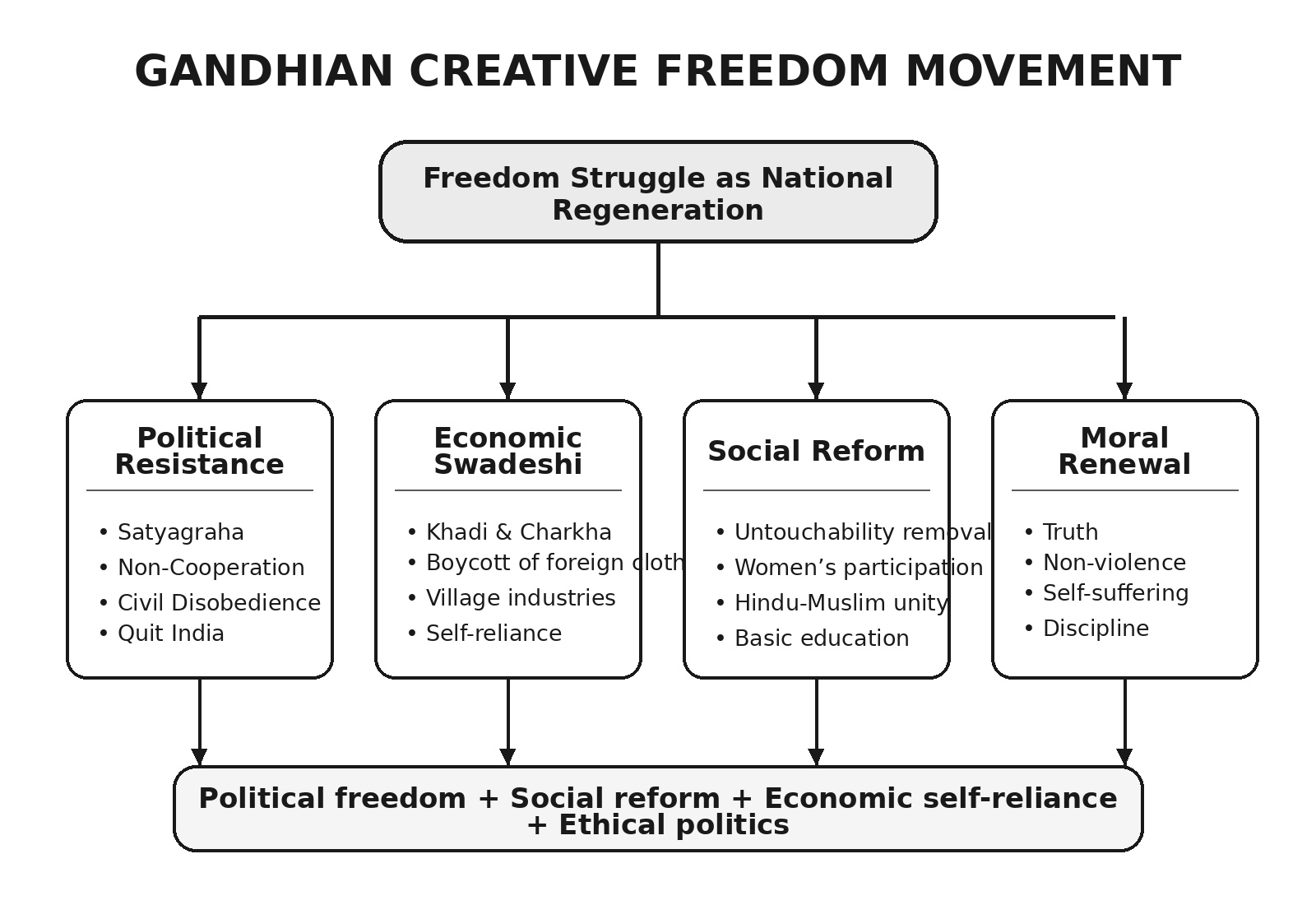
- Gandhiji converted freedom struggle into a people’s movement by using simple but powerful methods like Satyagraha, Non-Cooperation, Civil Disobedience and Quit India Movement. These movements allowed peasants, workers, women, students and traders to participate directly.
- However, his uniqueness was that he did not see freedom only as transfer of power. He linked political independence with constructive programmes. Through Khadi and Charkha, he promoted self-reliance, dignity of labour and boycott of foreign cloth. Through village industries, he challenged colonial economic exploitation and encouraged rural employment.
- Gandhiji also gave a social dimension to the freedom movement. He worked against untouchability, promoted Hindu-Muslim unity, encouraged women’s participation and emphasised basic education. Thus, freedom became a project of national regeneration.
- His methods were also morally creative. By using truth, non-violence, fasting, self-suffering and civil disobedience, he turned resistance into an ethical weapon. This gave Indian nationalism global moral legitimacy.
Conclusion
Thus, Gandhiji made the freedom struggle not merely anti-British, but pro-India—a movement for political freedom, social reform, economic self-reliance and moral awakening. This creative dimension made him the true mass leader of India’s national movement.

Mains Focus Group 2026 with Mentorship
Comprehensive lectures to make you Mains ready in 75 Days
Q3. The British education policy in India was narrowly focused on supplying clerks and translators for administrative purposes alone. in this context, critically evaluate the downward filtration strategy adopted by the colonial masters. (15 Marks)
Model Structure
Introduction:
- The ‘Filtration theory’, in the educational policy of India, was propagated by Lord Macaulay.
- According to which the Britisher focused on educating a small section of upper and middle classes Indians, thus creating a class of persons, Indian in blood and colour, but English in taste, in opinions, in morals, and in intellect.
Main Body:
The British education policy in India was narrowly focused on supplying clerks and translators for administrative purposes:
- Balance demand: There was a huge demand for clerks and other administrative roles in the company’s functioning.
- Cost Benefit: It was cheaper to get Indians rather than Englishmen from England for clerks and translators jobs
- Colonial Safeguard: They assumed that a few educated Indians would spread English culture to the masses and that they would be able to rule through this class of educated Indians.
Evaluation of the Downward Filtration Strategy adopted by the British:
- Low penetration of education: In 1911, the illiteracy rate in British India was 94%. In 1921, it was 92%.
- Thus, education remained the monopoly of the urban elites and excluded the masses
- Female education was ignored: This was because the government did not want to displease the orthodox nature of Indians and also because women could not generally be employed as clerks.
- Proselytizing tool: They established many schools with education only being a means to an end which was Christianizing and ‘civilising’ the natives.
- Destruction of the traditional education system: the British started on a mission to abolish the ancient gurukul system and sowed seeds for the cultural and linguistic upheaval of the country.
- Divide and Rule: The colonial legal system and the rise of caste consciousness since the second half of the nineteenth century only accentuated the problem.
- Caused the emergence of a modern stratification: The elite people never wanted their lower-class counterparts to enjoy what they had already started enjoying.
However, it also had positive impacts as well:
- New Thoughts: It helped Indians to develop modernity, secularism, democratic attitudes and rationality along with Nationalistic ideals.
- Unity in the thinking: It facilitated unity in the thinking process among the educated class and increased the idea of India as a nation.
- Scrutinizing the policies: the emergence of periodicals helped in scrutinising the policies and working of the government, which in turn enabled the Indians to have critical opinions on various issues.
- Growth of New social and religious reformation movements: propagated the thoughts of thinkers like J.S. Mill, Rousseau and Montesquieu among the educated youth of India.
- Role in administration: It provided a path to join government jobs for Indians and opportunities for Indians in Administration.
- Rise of the middle class: English education created a new class of people who went on to help reform Hindu society like Raja ram Mohan Roy, Ishwar Chandra Vidya Sagar etc.
Conclusion
- Though Modern education was one of the reasons behind the early freedom struggle and helped in the generation of national consciousness, Indians realised the shortcoming of the British education system, and since the late 19th century, the focus started shifting towards nationalised education which led to the creation of Universities like Gurukul Kangri and National Education board in 1905.
Q4. The permanent settlement system not only had economic implications, but it also ushered in a new social framework in Indian culture. Explain. (15 Marks)
Model Structure
Introduction:
- The Permanent Settlement was brought into effect by the Governor-General Lord Cornwallis in 1793. This was basically an agreement between the company and the Zamindars to fix the land revenue.
- First enacted in Bengal, Bihar and Odisha, this was later followed in northern Madras Presidency and the district of Varanasi. He envisaged the creation of a hereditary class of landlords in India. This system was also called the Zamindari System.
Main Body:
Key features of the system:
- Hereditary rights of succession: Landlords or Zamindars were recognised as the owners of the land. They were given hereditary rights of succession of the lands under them.
- Fixed Land Revenue payment: The amount to be paid by the landlords was fixed. It was agreed that this would not increase in the future (permanent in nature).
- The fixed amount was the 10/11th portion of the revenue for the government, and 1/10th was for the Zamindar.
The main economic implications raised due to this land revenue system were:
- Stagnation and Deterioration of Agriculture: Most of the absentee zamindars had their focus on the collection of maximum revenue rather than focusing on the betterment of agricultural land, in lack of good inputs and over-cultivation the quality of land increased.
- Impact on company revenues: By the first decade of the 19th century, cultivation slowly expanded, and prices rose in the market.
- Although this meant an increase in the income of Zamindars, it was no gain for the company since it could not increase a revenue demand that had been settled permanently.
- Increasing the commercialisation of land: Permanent Settlement led to a commercialisation of land that previously did not exist in Bengal.
- Absent landlordism further increased it, as it led to a change in the social background of the ruling class.
The permanent system also ushered in a new social framework in Indian culture:
- Detachment of zamindars from the land: Zamindars were not the same old hereditary landholders, now anyone could become a Zamindar provided he had good connections in the East India Company.
- Increase in social Inequality: This system strengthened feudalism in upper sections and slavery in lower sections of society.
- Absentee Landlordism: Most of the absentee zamindars had their focus on the collection of maximum revenue rather than focusing on the betterment of agricultural land; in the lack of good inputs and over-cultivation, the quality of land increased.
- Land Fragmentation: With generations, the land kept dividing among sons, which is the main reason for today’s agricultural land fragmentation.
- Famine and Poverty: Regular recurrence of famines was not just because of food grain scarcity but was a direct result of poverty unleashed by colonial forces in India.
- Between 1850 and 1900, about 2.8 crore people died in the famine.
- Distress Migration: The peasants were depressed by the excessive rent and by loans taken for the cattle, seed and other agricultural inputs.
Conclusion
- The Permanent Settlement of Cornwallis was bitterly criticised on the point that it was adopted with ‘undue haste'. The flagrant defect of this arrangement was that no attempt was made ever either to survey the lands or to assess their value. Thus, for other areas, new revenue collection systems, i.e., ryotwari and mahalwari were devised in subsequent years.
Q5. The main argument that was advanced in "Drain of Wealth" was that “a significant portion of India’s national wealth was transferred to England without any quid pro quo”. Examine the effects of the Drain of wealth on Indian society largely and the Indian economy specifically. (10 Marks)
Model Structure
Introduction:
- In 1867, Dadabhai Naoroji put forward the 'drain of wealth' theory in which he stated that Britain was completely draining India. Indian nationalist thinkers developed the theory of Drain mainly for analyzing the main cause of poverty in India.
Main body:
The consequence of the Drain of wealth was as follows:
- It impoverished all sections of Indian society, particularly the peasants, who bore the brunt of the taxes raised by the Britishers.
- It drained India of its precious capital, which could have otherwise been invested in the industrialization/ modernization of India.
- The drain of Indian wealth was used for financing the Industrial Revolution in England and is also the reason why the Industrial revolution did not take place in India.
- The economic criticism of British rule had helped in shattering the myth of benevolence of British administration in India.
- It was instrumental in laying the foundations for the demand for Swaraj and ensuing freedom struggle.
- stripped India of its productive capital and created a shortage of capital which hindered significant industrial development. This directly impoverished India along with stultifying the process of capital formation
- As per Dadabhai Naoroji’s opinion, the drain of resources was the major and sole cause of India’s poverty. Naoroji, R.C. Dutta and S.N. Banerjee were also of the opinion that the drain had created harmful effects on the level of income and employment in India. The drain had resulted in the loss of a generation of income and employment in the country.
Conclusion:
- Thus, British exploitative policies had lasting consequences on the Indian economy, employment, and inequality even till present times.