
Topics: Salient features of the World’s Physical Geography
Q1. Discuss the importance of the cryosphere in global climate regulation. (10 Marks)
Introduction:
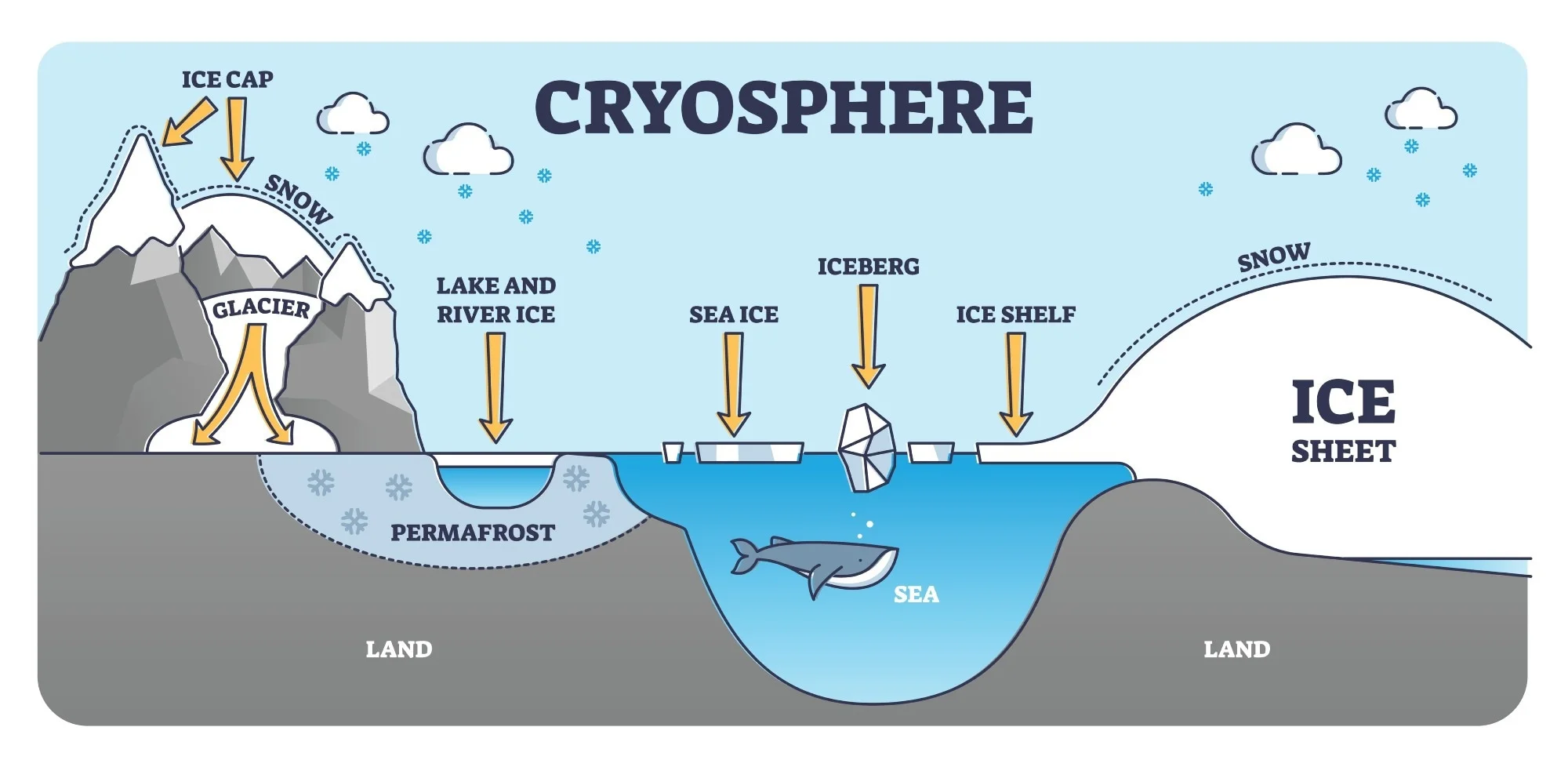
- The cryosphere is an umbrella term used to depict the portion of the Earth where water exists in solid form. It includes regions like Antarctica and Greenland, icebergs in the sea, and also higher mountain ranges like the Himalayas. OR
- According to the IPCC (Intergovernmental Panel on Climate Change) report, the global temperature will increase by more than 2 degrees by the end of the millennium. This has the highest level of impact on fragile regions like the cryosphere.
Main Body:
Importance of the cryosphere in climate regulation:
- Albedo effect: Albedo denotes reflecting capabilities; the cryosphere has higher albedo, which in turn cools the Earth.
- Carbon sink: Cryosphere is also a major carbon sink and has trapped carbon and methane within itself and the soil beneath.
- Reduction in the area of the cryosphere would release more greenhouse gases.
- Regulation of ocean currents: Any changes in the cryosphere tend to alter the rate of the thermohaline circulation, thus affecting the microclimates.
- The incidents of El Nino and La Nina are examples of this.
- Natural disaster: Excessive melting of the cryosphere could trigger global catastrophic events like rising sea levels, tsunamis, and avalanches.
Conclusion
- India has 7500km of coastline; any changes in the sea level would impact the social and economic aspects of the coastal community.
- India needs to raise its voice against the climate change that is affecting the cryosphere region. The Himalayas also hosts the largest ice apart from the poles; this also depicts concern related to North East and Himalayan states.
Q2. Contrast planetary and local winds by examining their sources, effects, and extent of occurrence. Highlight the significance of local winds in defining the climatic conditions of a given location. (15 marks)
Introduction:
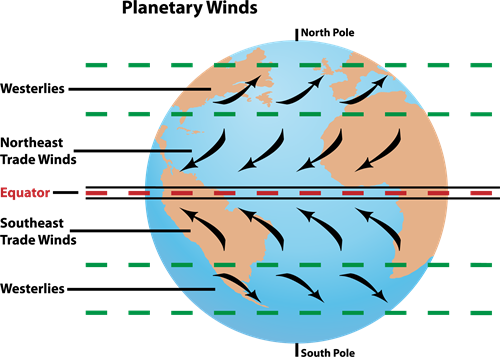
- Planetary winds are the wind that blows constantly throughout the year and in a constant direction. They blow extensively over oceans and continents.
- While local winds occur on a less spatial scale, their horizontal dimensions are typically some hundreds of kilometres. They tend to be short-lived, lasting only for some hours.
Main Body
Difference between Planetary and local winds:
Role of local winds in determining climate:
- Modify temperature: Hot winds raise temperature; cold winds lower it. Example: Loo in North India causes intense summer heat.
- Regulate coastal climate: Sea breeze cools coastal areas during the day. Land breeze affects night-time conditions. Example: Mumbai/Chennai have moderated temperatures due to sea breeze.
- Influence rainfall and humidity Moist winds increase humidity and may support rainfall. Example: Sea breeze brings moisture to coastal regions.
- Create dry conditions: Descending winds become warm and dry. Example: Foehn in Alps, Chinook in Rockies.
- Affect mountain-valley climate: Valley breeze warms slopes by day; mountain breeze cools valleys by night. Example: Himalayan valleys experience local temperature variation.
- Cause dust storms and aridity: Hot dry winds intensify dryness. Example: Sirocco from Sahara, Loo in Rajasthan/UP.
- Impact agriculture: Can damage crops, increase evaporation, or help snowmelt. Example: Chinook melts snow and benefits grazing lands.
- Affect human health and comfort: Hot/dusty winds cause heatstroke, dehydration and respiratory issues. Example: Loo in north-west India.
- Increase disaster risk: Dry winds can spread wildfires. Example: Santa Ana winds in California.
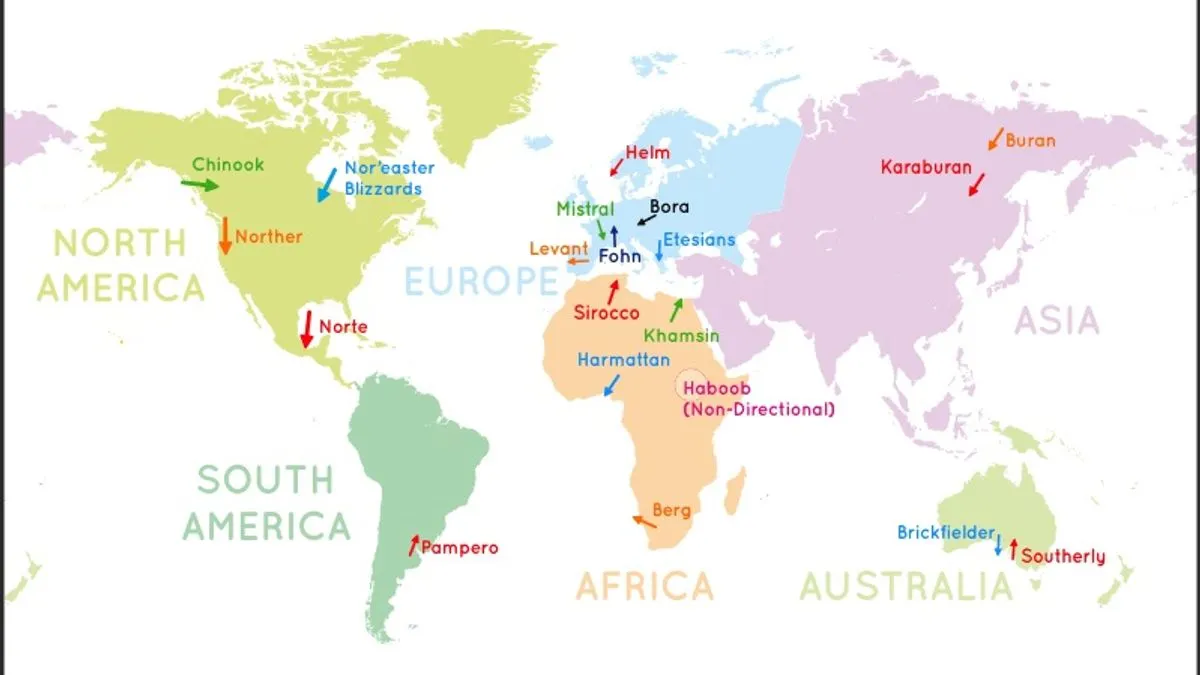
(diagram - local winds)
Conclusion
- Thus, these local winds have a significant influence on the local weather conditions and play a role in aggravating or moderating the larger climatic conditions in the area.

Sociology Test Series + Mentorship
Special LIVE sessions on Sociology Current Affairs and Value Addition Sessions
Q3. Rivers of peninsular India are rainfed with their mouths scattered all around but majority of them drain into the Bay of Bengal. Discuss the reasons behind this and its impact. (15 marks)
Model Structure
Introduction
- The Indian drainage system is broadly classified into peninsular rivers like Krishna, Mahanadi etc, extra peninsular or Himalayan rivers like Ganga, Indus etc, coastal rivers like Savitri, Mahi etc, and inland rivers like Sambhar and Luni.
Main Body
All the rivers empty into either Arabian Sea or Bay of Bengal with the former getting only 23% of the discharge whereas the latter receiving 77% of river discharge.
Reasons behind asymmetrical drainage pattern
- Western ghats have higher elevation as compared to Eastern ghats thus difficult to dissect for rivers and drain into Arabian Sea.
- Slope of peninsula and northern plains is aligned from west to east due to which rivers like Godavari, Krishna, Ganga, Mahanadi etc drain into the Bay of Bengal.
- Western branch of advancing monsoons causes less precipitation as compared to eastern branch which also picks moisture from the Bay of Bengal. This is evident from very low rainfall received by Gujarat, Rajasthan and interiors of Maharashtra when compared to Ganga and Brahmaputra river basin.
- Himalayan rivers are glacier fed thus perennial but peninsular rivers are seasonal as they are rain fed. Now that all the Himalayan rivers in India flow into Bay of Bengal, the discharge is high.
- Rivers on eastern coast receive rainfall both from advancing and retreating monsoons thus more discharge is there into Bay of Bengal.
- Higher frequency and intensity of tropical cyclones in the Bay of Bengal as compared to Arabian Sea is another reason.
Impact of asymmetrical drainage system
- More influx of river water into Bay of Bengal means more cool and freshwater is added which creates a separate horizontal zone of warm water and cooler water which is conducive for cyclonic activity.
- Less rivers in western areas make it hot and dry leading to water scarcity and less developed agriculture. This makes canal Irrigation more prominent in this region.
- The above mentioned water situation makes this area contribute to dryland farming and more cultivation of nutria cereals.
- This non-mixing of surface water with water below makes Bay of Bengal warmer than the Arabian Sea making it ideal for cyclones.
Conclusion
- Many recent reports like that of IPCC have warned of a water crisis and actions need to be taken to save existing rivers and rejuvenate the older ones. Government's ambitious program of interlinking of the river may help decrease this lopsided nature of drainage in India
Q4. Elaborate on how thermohaline circulation functions to maintain energy balance. Additionally, analyse the consequences of a weakened Atlantic Meridional Overturning Circulation (AMOC) on the global climate. (15 marks)
Introduction:
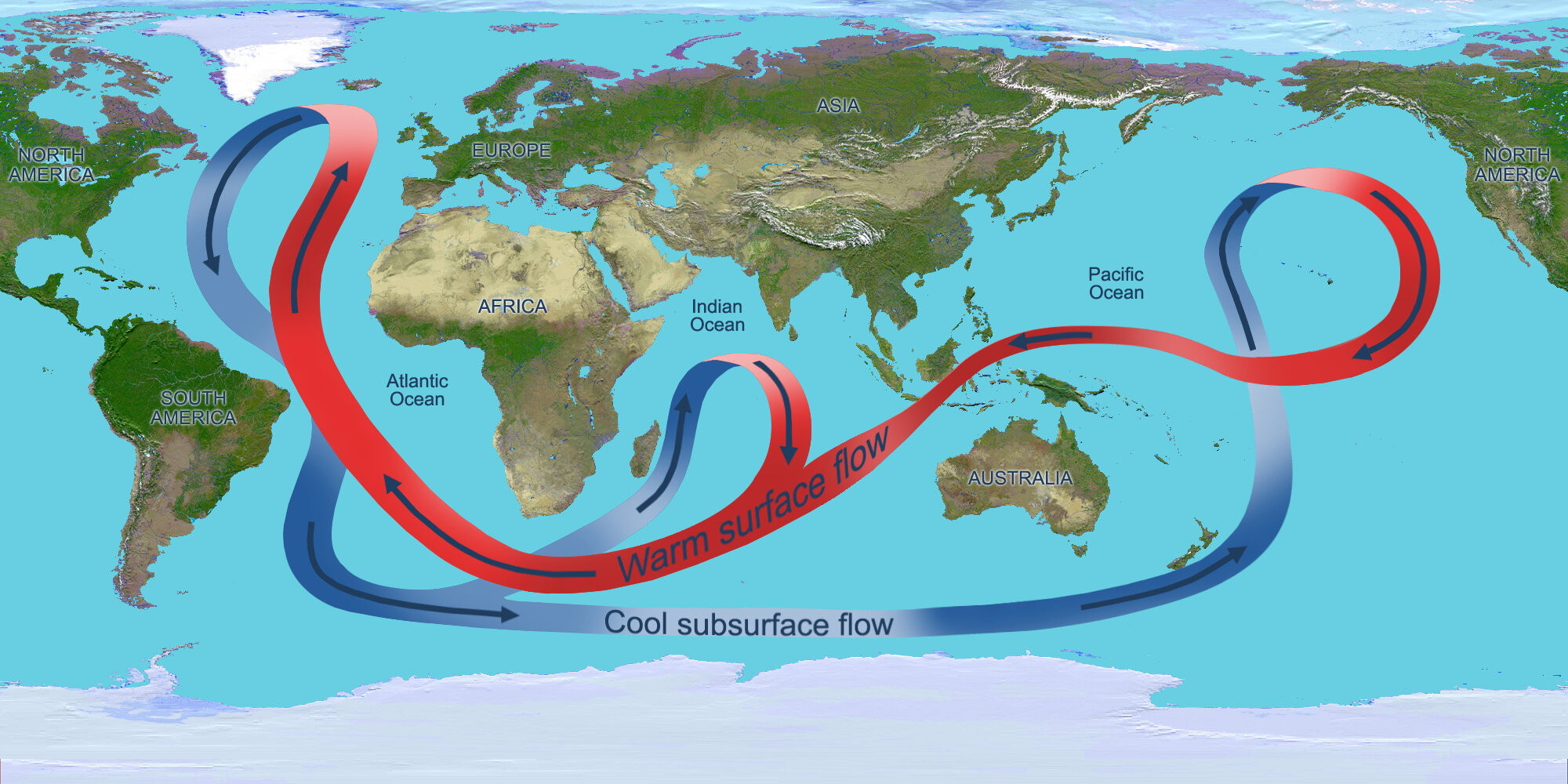
- The deep-ocean currents are driven by differences in the water’s density, which is controlled by temperature (thermos) and salinity (halite). This process is known as thermohaline circulation.
- Atlantic Meridional Overturning Circulation (AMOC) is a large system of ocean currents. It is the Atlantic branch of the ocean conveyor belt or Thermophiles Circulation(THC) and distributes heat and nutrients throughout the world’s ocean basins.
Main Body:
Thermohaline circulation acts as a means and process of energy balance:
- Formation of ice: In the Earth's polar regions, ocean water gets very cold, forming sea ice.
- Consequently, the surrounding seawater gets saltier because when sea ice forms, the salt is left behind.
- Density increase: As the seawater gets saltier, its density increases, and it starts to sink.
- Pulling up of surface water: Surface water is pulled in to replace the sinking water, which in turn eventually becomes cold and salty enough to sink.
- This initiates the deep-ocean currents driving the global conveyor belt.
- Transfer of heat: The thermohaline circulation plays an important role in supplying heat to the polar regions and, thus, in regulating the amount of sea ice in these regions and moderating the climate of polar regions.
- These ocean currents help to counteract the high levels of solar radiation that the Earth’s equator receives.
Although this process is relatively slow, tremendous volumes of water are moved, which transport heat, nutrients, solids, and other materials over vast distances. Thus, this process aids in distributing heat and energy around the earth (heat budget) by transferring warm water to polar regions and cold water from the poles to the tropics. Without these currents, it would be much hotter at the equator and much colder at the poles, making planet Earth’s surface less livable.
Weakening of AMOC can lead to:
- Decreased temperature and rainfall over Europe.
- Prominent cooling over the northern Atlantic region and neighbouring areas, sea ice increases over the Greenland-Iceland-Norwegian seas and to the south of Greenland.
- A significant southward rain-belt migration over the tropical Atlantic.
- Increase in winter storms over Europe and stronger hurricanes in the US.
A collapse of the AMOC may induce causal interactions like
- Changes in ENSO [El Niño–Southern Oscillation] characteristics.
- Dieback of the Amazon rainforest due to less rainfall
- Shrinking of the West Antarctic Ice Sheet.
- Southern migration of the ITCZ [Intertropical Convergence Zone] and the tropical rain belt.
- Large warming of the Southern Ocean.
- Weakening of the African and Asian monsoons, thus less Sahelian summer rainfall and South Asian summer rainfall and strengthening of Southern Hemisphere monsoons.
- Sea level rise due to piling up of water at the USA’s east coast as there is less sinking of cold water downward in high latitudes.
Conclusion
- There is a need to reconcile climate models with the presented observational evidence by improving long-term monitoring of the AMOC and improving understanding of past AMOC changes.
Q5. Deep-sea mining is an evolving area due to the exhaustion of resources on land. Discuss the benefits of deep-sea mining and the issues involved in this activity. (15 marks)
Model Structure
Introduction
- Oceans make up around 70% of Earth’s surface which makes them potentially an abode of minerals. This has opened new avenues in deep sea mining which has reserves of polymetallic nodules, sulfur mines, red clay deposits and manganese nodules.
Main Body
- Unsustainable mining has huge disadvantages like destruction of subsoil, change in land use, decreased agricultural productivity and pollution of various kinds. Exhaustion of resources pushes the price of minerals resulting in inflation.
- Deep sea mining provides endless opportunities due to huge untapped resources.
Benefits of deep sea mining:
- Many countries are deficient in resources and they can explore and extract them from the ocean floor for domestic uses.
- As per a few studies, the quality of manganese and copper is far better than what is extracted on land.
- Many cross border disputes have occurred due to resources. Like Alsacce Lorraine between France and Germany was a minor reason for World Wars. Exploitation of oceanic resources can help avoid such situations.
- Availability of resources fuels industrialisation and seabed mining can help spur it in less developed countries.
Issues
- Mining involves intrusion of heavy machinery and dredging which will surely degrade the sea bed and the habitat to many species.
- Species extinction is another threat if mining continues for unabated time which can disturb the ecological balance.
- Deep sea mining involves use of heavy machinery and sophisticated techniques which requires heavy capital investment. This is not feasible for many small countries.
- Also, there is the issue of international boundaries and territorial waters. Mining near closely located countries can affect regional peace and give rise to international disputes.
- Marine vehicles and the resulting pollution along with occasional oil spills can affect the whole ecosystem and impact regional climate.
- Many creatures use echolocation and sound waves to travel and survive. But invasion of pristine areas by humans can impact this daily life of animals and plants which can have long lasting impacts.
Conclusion
- Deep sea mining is a good alternative considering the exhaustion of land resources but it has to be sustainable to ensure that disputes like those on land do not arise. Also, the interests of small countries and ocean life needs to be taken care of.

GS Advance + Mentorship (for Mains 2027)
Complete coverage of the entire UPSC Mains Syllabus: Advanced level