
Topic: Distribution of key natural resources across the world (including South Asia and the Indian sub- continent); factors responsible for the location of primary, secondary, and tertiary sector industries in various parts of the world (including India)
Q1. Enumerate the factors contributing to the industry's location in an area. Also, analyse the changing dynamics of industrial sites influenced by footloose industries, which are no longer constrained by traditional factors. (10 marks)
Model Structure
- Introduction (1): A footloose industry is not tied to any particular location or country and can relocate to another place without effect from factors of production such as resources, land, labour, and capital. For e.g Diamonds, the computer chips manufacturing industry. They don't need a large place for manufacturing and have a low-weight output. or
- Introduction(2): These are called footloose as these types of industries are prone to relocation. Some prominent examples of the footloose industry are watch-making, diamond cutting, precision electronics etc. These industries often have spatially fixed costs, i.e., the costs of the products do not change despite where the product is assembled.
Main Body:
- Factors affecting the location of industries: (Question asks to enumerate - so just mention the factors - no need to explain them)
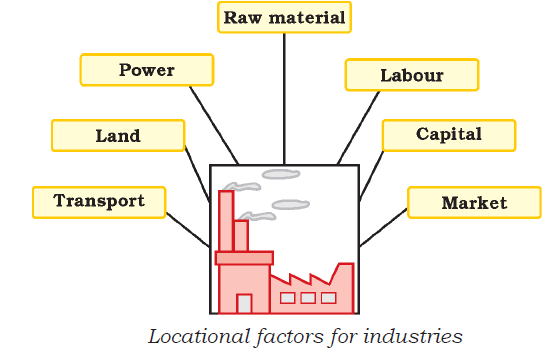
Advantages of Footloose industries over traditional industries:
- Raw material: These are less dependent on specific raw materials, most of the raw materials are small and light and can be transported easily.
- Market: the output is lightweight and can be easily transported to the markets. Most of the footloose industries produce low-volume and high-value outputs.
- Government regulations: These are environment-friendly industries as the process involved in these industries has a negligible carbon footprint, so are least affected by government regulations.
- Energy: these are not very energy-intensive industries. They are powered by electricity which can be found anywhere.
- Port facilities: They are not very heavy industries which require port facilities for their transportation. Thus, they have advantages for those areas which lack port facilities.
Conclusion
- These industries are crucial for the development of areas which lack locational advantages concerning heavy and small industries like port facilities, availability of raw materials, etc. OR
- Good development of the footloose industry can provide high-value employment opportunities and a competitive advantage in world trade.
Q2. Explain the factors contributing to the increasing significance of rare earth metals in recent years. Discuss their distribution patterns and impact on global industries. (10 marks)
Model Structure
Introduction:
- Rare earth elements are a group of seventeen metallic elements with unique properties used in diverse technologies, including electronics, healthcare, and defence. They are called 'rare earth' because earlier, it was difficult to extract them from their oxide forms technologically.
Main Body
Importance of rare earth elements:
- Cell phones: For cell phones to vibrate, they need powerful magnets, and REEs are critical to the manufacture of these powerful permanent magnets.
- Electric vehicles: with the rising concern of climate change and air pollution and the need to shift to cleaner vehicles, demand for EVs has increased, and to run EV motors, powerful magnets are required, which are obtained from these REEs.
- National defence: rising geopolitical tensions in the world have increased the country's expenditure on defence supplies.
- The typical F-35 fighter contains nearly 1,000 pounds of rare earth.
- Significant defence applications include electronic displays, guidance systems, lasers, and radar and sonar systems.
- Consumer electronics: with rising consumerism and fast-changing technology developments in the electronics industry, demand for electrical products have increased in the last few decades.
- These products are a major consumer of REE, like laptops, television etc.
- Renewable energy: They have applications in Hybrid automobiles, wind turbines, next-generation rechargeable batteries, and biofuel catalysts.
- Even futuristic technologies need these REEs (For example, high-temperature superconductivity, safe storage and transport of hydrogen for a post-hydrocarbon economy, environmental global warming and energy efficiency issues).
Distribution of rare earth elements:
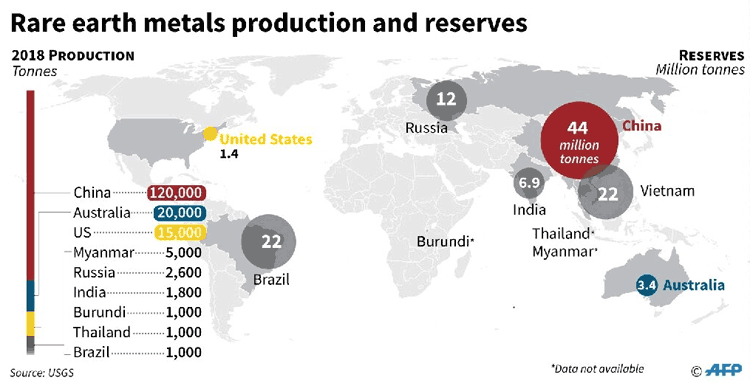
Influence on global industry growth
- China’s monopoly: China is witnessing maximum industrialisation in industries which require rare earth elements, such as the electronics industry, because it produces 60% of global REE production.
- China also accounts for the maximum global rare-earth consumption.
- China had announced plans to reduce its export quota to 35000 tons per year in 2010-2015. This triggered some panic in global markets.
- Automotive industry: The COVID-19 pandemic has impacted the supply of rare earth elements for the automotive industries, especially since the virus impacted China.
- This led to the breaking of international supply chains. Car manufacturers had announced a halt in production.
Conclusion
- With the global shift towards electric vehicles and cleaner energy sources to fulfil Paris Agreement conditions, demand for REE is expected to increase. The need of the hour is to diversify production and search for other alternatives.

Q3. The discovery and extraction of oil in the Arctic Sea have various economic and environmental consequences.? Discuss (15 Marks)
Model Structure
Introduction:
- According to U.S. Geological Survey estimates, the Arctic sea has 90 billion barrels of oil and 44 billion barrels of natural gas liquids. There may also be significant reserves of coal, zinc and silver.
- With current oil reserves coping with increased pressure, the Arctic and its seas are seen as being of crucial importance. The recent discovery of mineral resources in the Arctic brought back its significance in terms of economic development. Resources such as petroleum and natural gas may start a race between countries for extraction.
Main Body:
The economic significance of oil discovery in the Arctic:
- Reduction of oil prices: The discovery and extraction of oil will increase its abundance in the market, and as a result, the prices of oil will come down.
- Economic growth in developing countries: The reduction in prices will particularly help developing countries to achieve rapid economic growth.
- Energy Security: Exploration of energy fuels will lead to energy security for the world as the world is facing resource scarcity.
- Diversification of energy resources: Decreased reliance on the Middle East region (Gulf nations), thereby altering the geo-political and economic relationships among the global community.
- Increased investment expenditure and job creation by means of new drilling of oil wells and establishment of necessary backwards and forward linkages.
- Impact on the fishing industry: With new infrastructure, the commercial fishing industry would also develop faster in this region.
Possible Environmental Repercussions:
- Reduced focus on renewable energy: As the prices of conventional fuel fall due to increased production, the economic viability of investing in renewable energy will also fall.
- This will reduce global efforts to focus on switching to clean energy in the future.
- Marine pollution: Petroleum extraction is a polluting process, and exploiting the resources in sensitive areas of the Arctic will result in pollution of the seas.
- Sea level rise: The process of extracting petroleum from ice-covered seas will involve the melting of sea ice before mining.
- The process will melt large areas of sea ice and will result in increasing sea levels that may drown large coastal areas.
- The temperature of the globe may also increase.
- Impact on Oceanic Circulation: Global warming will lead to the melting of ice and thus weakening of the global thermohaline circulation as a result of the increased flux of freshwater from the Arctic Ocean.
- Risk of the oil spill and inability to clean up: The cold and inaccessible nature of the region makes responding to disasters in the region extremely difficult.
Conclusion:
- The Arctic marine environment is not pristine, as commonly imagined, but is facing numerous pressures, the most serious arguably coming from outside the region. At the regional level, the Arctic Environmental Protection Strategy (AEPS) should be implemented properly as adopted by eight rim states around the Arctic.
- Recently, in its sixth assessment report, the Intergovernmental Panel on Climate Change (IPCC) has highlighted that human influence is very likely the main driver of the global retreat of Arctic Sea ice during the last 40 years. Thus, there is an urgent need to take steps to protect the Arctic ecosystem.
Q4. Despite a bountiful reserve of coal, its shortage has become systematic and perennial. Highlighting the causes, recommend some corrective measures. (15 Marks)
Model Structure
Introduction:
- India ranks 5th in the world in terms of coal reserves and is the second largest producer of coal. The proven reserves are equivalent to 111.5 times our annual consumption.
- According to data from the Central Electricity Authority (CEA), coal stocks across the 180 thermal power plants under the ambit of CEA stood at 25.59 million tonnes, 47% of the required stock of 54.16 million tonnes as on October 2022.
Main Body:
Causes of coal shortage:
- Monopoly of Coal India Limited (CIL) hampers the free/competitive trade of coal.
- Poor management of the coal supply chain has resulted in inefficient usage/distribution of coal.
- High freight rates, delays in deliveries, and defaults on payments by power companies.
- Poor inventories: Coal inventories at the power plants have consistently declined to about 13% since April (2022) to the lowest pre-summer levels.
- Rising temperatures: The peak demand for power has increased with the early onset of summer.
- E.g., the demand for power in Delhi rose by 42% in the month of April 2022.
- International factors: Russia-Ukraine crisis has resulted in the disruption of the international coal supply. India’s dependence on imports for its coal requirements has increased from 6% (2000-01) to 21.7% (2021-22).
- Climatic factors: As per center's Core Management Team (CMT), heavy rains in the coal mining areas have resulted in lesser than usual coal production.
- Increasing power demand/slow growth in production: a substantial increase in the power demand without a corresponding increase in production.
- E.g., as per a report, power demand has increased to 124.2 BU per month in 2021 from 106.6BU per month in 2019.
In order to ensure an adequate supply of coal, there is a need to take the following corrective measures:
- Streamlining the supplies of already available coal with dedicated freight corridors and real-time tracking. E.g., Rail SUGAM.
- Enhancing the reach of Smart Grid, to minimize power wastage and stealing and to encourage house owners to generate more electricity through rooftop-solar etc.
- Incentivizing miners and popularizing schemes like HELP to ensure domestic exploration/supplies.
- Transparent mechanism to ensure timely payments to avoid delays in supplies.
- Diversification of the energy sector is the need of the hour. Renewable energy targets need to be enhanced and met in a time-bound manner.
- Enhancing competitiveness in the sector by encouraging more companies, especially the private sector in the coalfield.
Conclusion
- The Indian economy is overly dependent on coal, and it is thus a strategic resource for India. To ensure our energy security, the focus is needed on both fronts- enhancing coal production as well as gradually phasing down coal usage.
Q5. It is often said that Lithium is the ‘new oil’. Explain the distribution of lithium across the globe. Are there any lithium reserves in India? (15 Marks)
Introduction
- Lithium is often called the new oil/white gold because it is the ultralight battery metal. The other reason for the spike has been the global rush towards environmentally friendly modes of transport.
Main Body
Distribution of lithium across the world:
- Lithium reserves have been found in all the continents, but Chile, Argentina and Bolivia together are referred to as the “Lithium Triangle”, holding underneath in its salt flats more than 75 % of the world supply.
- Australia, Argentina and Chile are the world's top lithium producers, while Bolivia holds the largest potential resources.
- China, meanwhile, is also a significant producer. Together, these five countries account for most of the world's lithium supply.
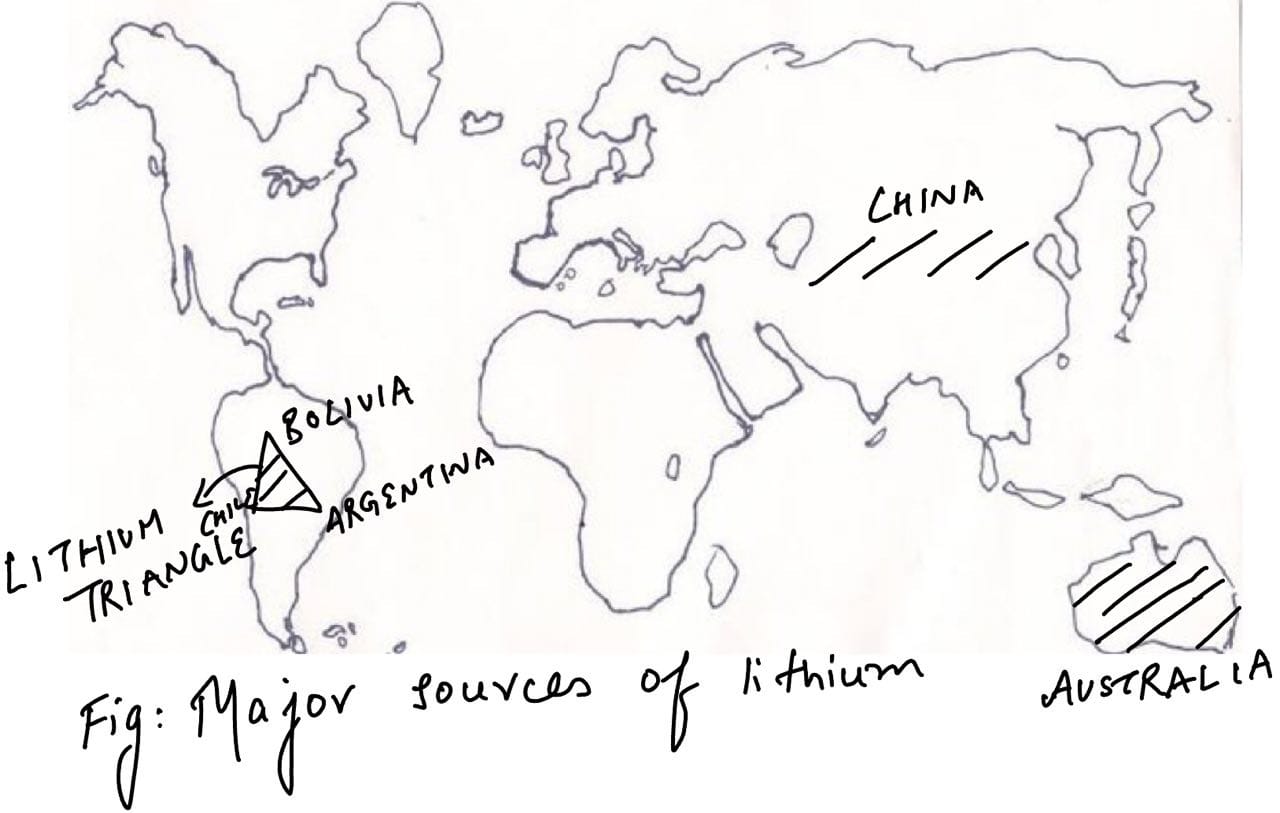
Lithium reserves in India:
- During 2021-22 Geological Survey of India (GSI) has carried out 7 projects on Lithium in Arunachal Pradesh, Andhra Pradesh, Chhattisgarh, Jharkhand, Jammu & Kashmir and Rajasthan. However, the resource of lithium has not yet been augmented by GSI.
- Researchers at the Atomic Minerals Directorate (AMD) for Exploration and Research have estimated lithium reserves of 14,100 tonnes in a small patch of land surveyed in Southern Karnataka’s Mandya district.
- Potential sites in India include -
- The major mica belts in Rajasthan, Bihar, and Andhra Pradesh.
- Pegmatite (igneous rocks) belts in Odisha and Chhattisgarh.
- Brines of Sambhar and Pachpadra in Rajasthan, and Rann of Kachchh in Gujarat.
Conclusion
- Almost 100% of Li-ion batteries or cells are imported in India. Considering this, India needs to secure access to Lithium reserves.

Mains Focus Group 2026 with Mentorship
Comprehensive lectures to make you Mains ready in 75 Days