Table of contents
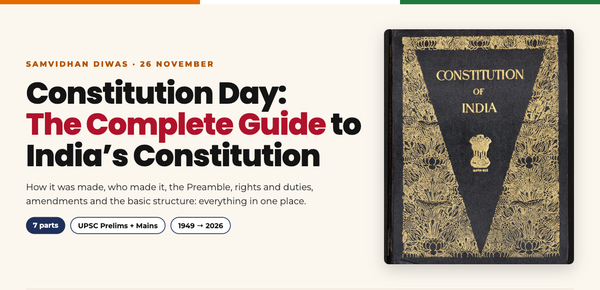
Every year on 26 November, India celebrates Constitution Day, or Samvidhan Diwas. On that day in 1949, the Constituent Assembly adopted the Constitution of India, the longest written constitution in the world and the rulebook for more than 140 crore people.
This guide explains the Constitution from start to finish in seven parts, written for students, UPSC aspirants and any curious citizen:
- What Constitution Day is, and why it falls on 26 November
- How the Constitution was made
- The people who made it
- The Preamble, the Constitution's soul
- The features that make it unique, and where they came from
- Fundamental Rights, Directive Principles, Fundamental Duties and the Schedules
- Amendments, the basic structure doctrine and key facts
Constitution QUIZ!
Before reading further, can you answer these questions?
After reading this article, try solving a collection of Advanced Questions at the end of this article.
Part 1: What is Constitution Day?
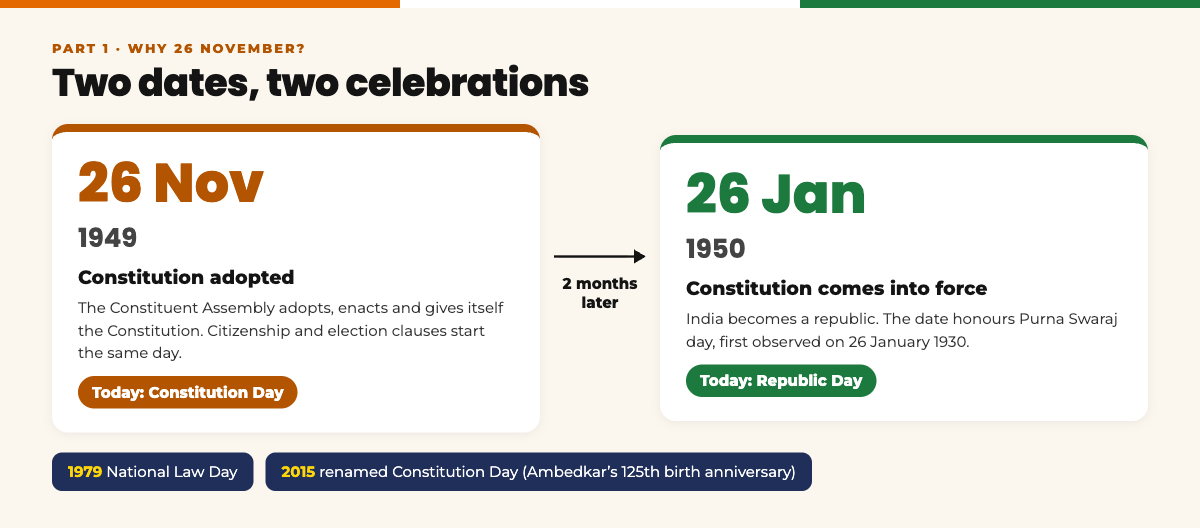
Constitution Day (Samvidhan Diwas) is observed every year on 26 November to mark the adoption of the Constitution of India by the Constituent Assembly on 26 November 1949. It honours Dr. B.R. Ambedkar and all the framers, and is a day to reflect on the values the Constitution protects.
Why 26 November, and not 26 January?
India has two constitutional dates, and each has its own meaning.
Date | What happened | How it is marked today |
|---|---|---|
26 November 1949 | The Constituent Assembly adopted the Constitution. A few provisions (citizenship, elections, the provisional Parliament and some temporary clauses) took effect the same day. | Constitution Day |
26 January 1950 | The rest of the Constitution came into force and India became a republic. | Republic Day |
26 January was chosen on purpose. On 26 January 1930, the Indian National Congress had called on the country to observe Purna Swaraj (complete independence) day, following its Lahore session resolution of December 1929. Bringing the Constitution into force on that date linked the new republic to the freedom struggle.
The Preamble itself records the adoption date: "In our Constituent Assembly this twenty-sixth day of November, 1949, do hereby adopt, enact and give to ourselves this Constitution."
How the day began
- 1979: 26 November began to be observed as National Law Day, an initiative of L.M. Singhvi, then president of the Supreme Court Bar Association.
- October 2015: Prime Minister Narendra Modi announced that the day would be celebrated as Constitution Day, while laying the foundation stone of the Dr. B.R. Ambedkar memorial in Mumbai.
- 19 November 2015: the government notified 26 November as Constitution Day. The year marked Dr. Ambedkar's 125th birth anniversary.
Constitution Day 2026
According to the Press Information Bureau (25 November 2026), this year's observance includes:
- Online reading of the Preamble on the MyGov portal in 23 languages (the 22 Scheduled Languages and English), facilitated by the Ministry of Parliamentary Affairs. Participants can download a certificate.
- Constitution Quiz on the MyGov and MyBharat portals, from 18 to 26 November.
- Viksit Bharat Yuva Samvad across 786 districts in all 36 States and Union Territories, from 24 to 26 November.
- Collective Preamble readings, seminars, quizzes, essay and debate competitions, poster-making, walks and runs in ministries, states, schools and colleges.
The Dr. Ambedkar Foundation's theme for the year is "The Constitution @76: Dr. B.R. Ambedkar's Constitutional Vision and the Future of Indian Democracy".
Part 2: How the Constitution was made
India's Constitution was written by a Constituent Assembly over 2 years, 11 months and 18 days, from its first meeting on 9 December 1946 to its adoption on 26 November 1949.
The road to a Constituent Assembly
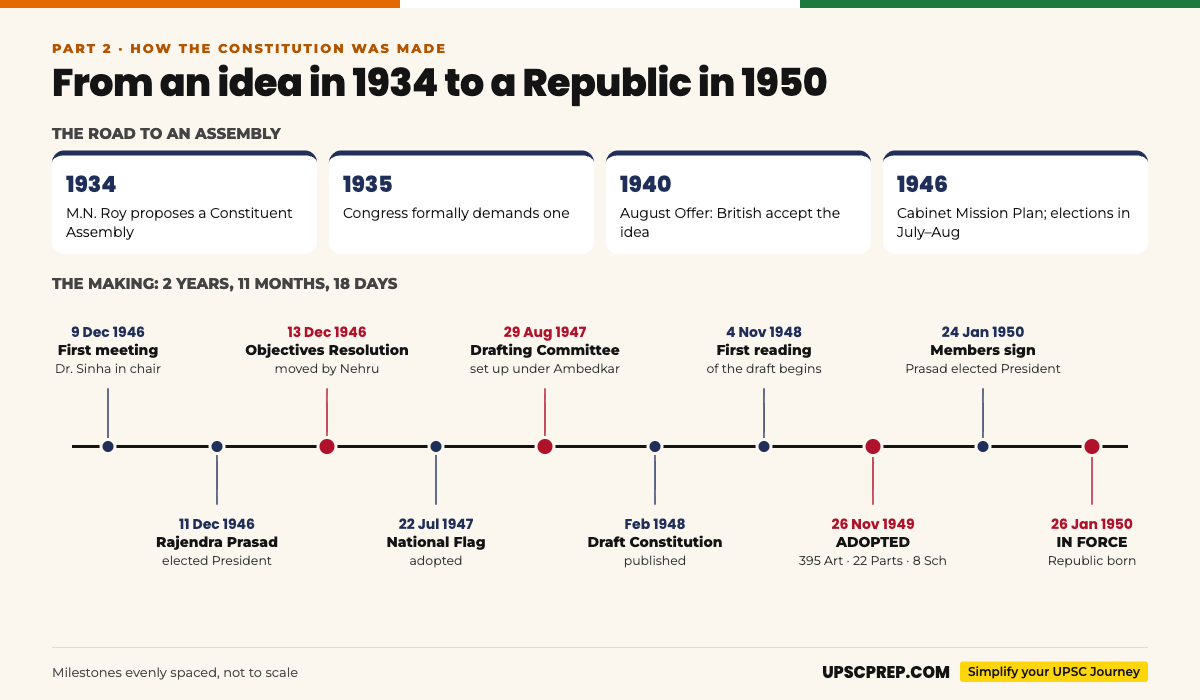
The idea of Indians writing their own constitution grew through the freedom movement. M.N. Roy first proposed a Constituent Assembly in 1934. The Indian National Congress formally demanded one in 1935. The British accepted the demand in principle through the August Offer of 1940, and the Cabinet Mission Plan of 1946 finally set out how the Assembly would be formed.
Key dates
Date | Event |
|---|---|
1934 | M.N. Roy proposes a Constituent Assembly |
1935 | Congress formally demands a Constituent Assembly |
1940 | August Offer: the British accept the demand |
July–August 1946 | Elections to the Constituent Assembly under the Cabinet Mission Plan |
9 December 1946 | First meeting; Dr. Sachchidananda Sinha is the temporary chairman. The Muslim League stays away. |
11 December 1946 | Dr. Rajendra Prasad is elected permanent President of the Assembly |
13 December 1946 | Jawaharlal Nehru moves the Objectives Resolution |
22 January 1947 | The Objectives Resolution is adopted; it later becomes the basis of the Preamble |
22 July 1947 | The National Flag is adopted |
29 August 1947 | The Drafting Committee is set up under Dr. B.R. Ambedkar |
February 1948 | The Draft Constitution is published for public comment |
4 November 1948 | Dr. Ambedkar moves the draft in the Assembly; the first reading begins |
26 November 1949 | The Constitution is adopted |
24 January 1950 | Final session: members sign the Constitution, the National Anthem and National Song are adopted, and Dr. Rajendra Prasad is elected the first President of India |
26 January 1950 | The Constitution comes into force |
Who sat in the Assembly
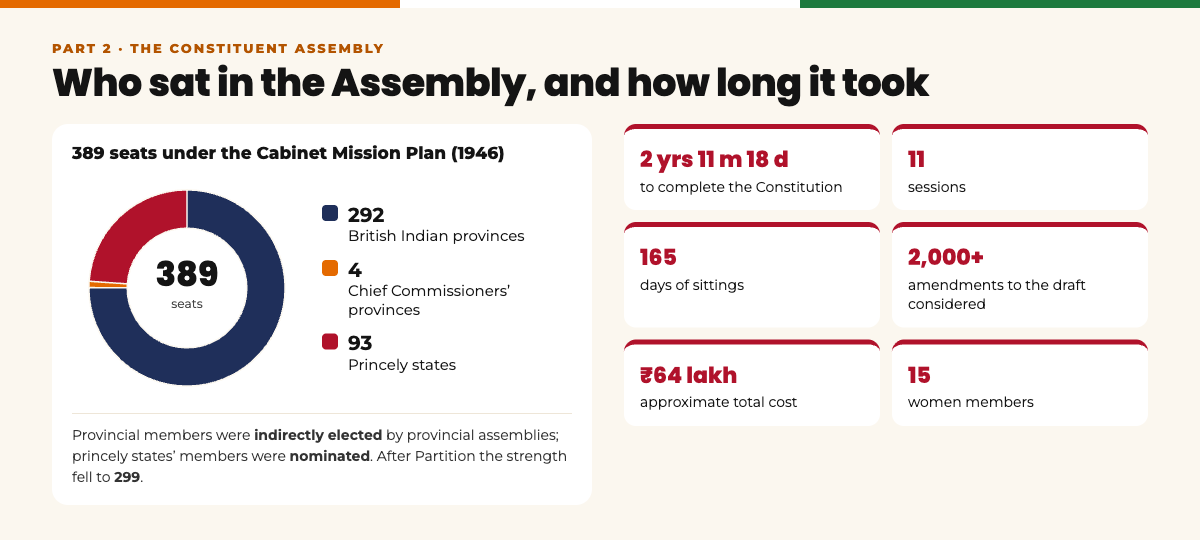
Under the Cabinet Mission Plan, the Assembly had 389 seats, roughly one for every 10 lakh people:
- 292 members from the provinces of British India
- 4 from the Chief Commissioners' provinces
- 93 from the princely states
Members from the provinces were indirectly elected by the provincial legislative assemblies through proportional representation by single transferable vote. Members from the princely states were nominated by their rulers. The Assembly was therefore not elected directly by the people on the basis of adult franchise, a point often raised by its critics.
After Partition, members from the areas that went to Pakistan left, and the Assembly's strength fell to 299.
The Assembly in numbers
- 11 sessions and 165 days of sittings
- More than 2,000 amendments to the draft were considered
- Total cost of about ₹64 lakh
- 15 women members
Two roles at once
After independence on 15 August 1947, the Assembly did two jobs. As a constitution-making body it was chaired by Dr. Rajendra Prasad. As the Dominion legislature, India's first Parliament, it was chaired by G.V. Mavalankar. After 26 January 1950 it continued as the provisional Parliament until the first general elections of 1951–52.
Part 3: The people behind the Constitution
Dr. B.R. Ambedkar led the drafting, but the Constitution was the work of hundreds of members, a dozen committees and a small team of experts and artists.
The Drafting Committee
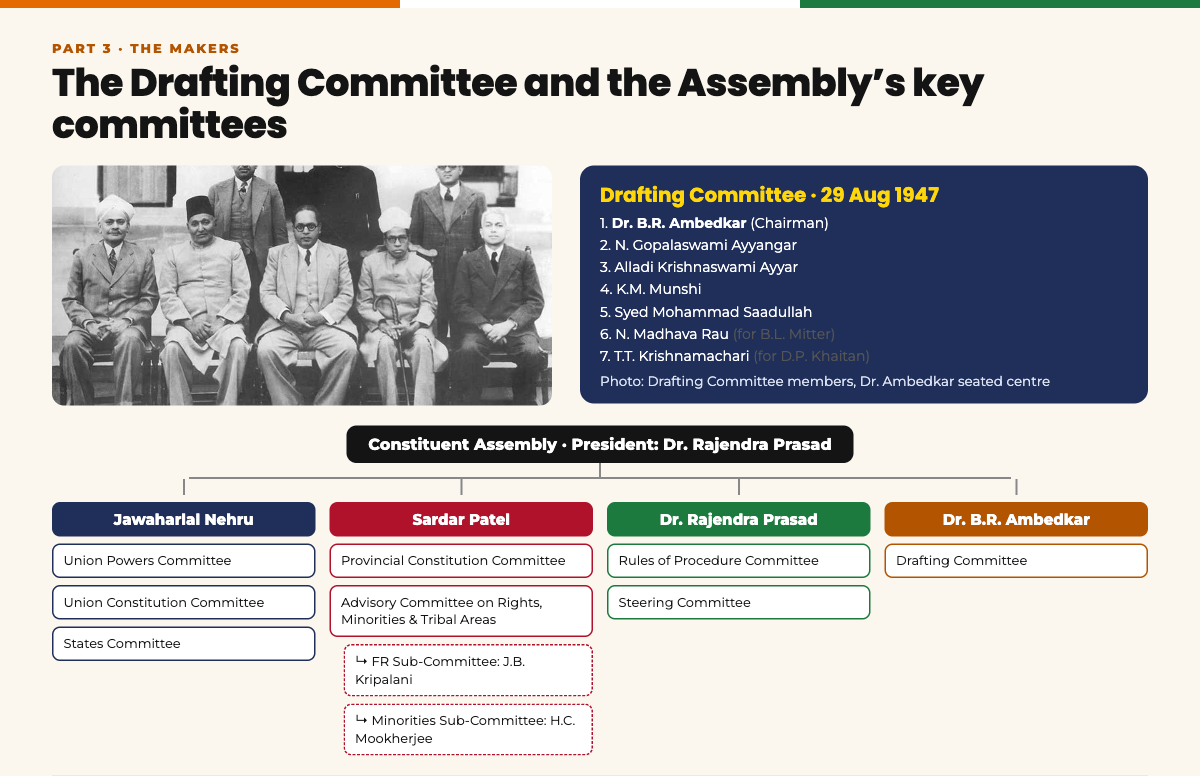
The Drafting Committee was set up on 29 August 1947 with seven members:
- Dr. B.R. Ambedkar (Chairman)
- N. Gopalaswami Ayyangar
- Alladi Krishnaswami Ayyar
- K.M. Munshi
- Syed Mohammad Saadullah
- N. Madhava Rau (replaced B.L. Mitter, who resigned)
- T.T. Krishnamachari (replaced D.P. Khaitan, who died in 1948)
Ambedkar steered the draft through the Assembly, answered its debates clause by clause, and is remembered as the chief architect of the Constitution.
Major committees and their chairs
The Assembly split its work among committees. These are the ones most often asked about:
Committee | Chair |
|---|---|
Union Powers Committee | Jawaharlal Nehru |
Union Constitution Committee | Jawaharlal Nehru |
States Committee (talks with the princely states) | Jawaharlal Nehru |
Provincial Constitution Committee | Sardar Vallabhbhai Patel |
Advisory Committee on Fundamental Rights, Minorities and Tribal and Excluded Areas | Sardar Vallabhbhai Patel |
Fundamental Rights Sub-Committee | J.B. Kripalani |
Minorities Sub-Committee | H.C. Mookherjee |
Rules of Procedure Committee | Dr. Rajendra Prasad |
Steering Committee | Dr. Rajendra Prasad |
Drafting Committee | Dr. B.R. Ambedkar |
Other key figures in the Assembly
- Dr. Rajendra Prasad: President of the Assembly, later the first President of India.
- H.C. Mookherjee: Vice-President of the Assembly and chair of the Minorities Sub-Committee.
- Jawaharlal Nehru: moved the Objectives Resolution and chaired three major committees.
- Sardar Vallabhbhai Patel: chaired the committees on provinces and on rights and minorities, and led the integration of the princely states.
- Maulana Abul Kalam Azad, Syama Prasad Mookerjee, Jaipal Singh, Baldev Singh and Somnath Lahiri were among the members who brought very different views to the debates. Jaipal Singh, for example, spoke strongly for the rights of Adivasis.
Behind the scenes
- Sir B.N. Rau, the Constitutional Advisor, prepared the first draft for the Drafting Committee.
- S.N. Mukherjee was the chief draftsman.
- Prem Behari Narain Raizada wrote the English original by hand in flowing italic calligraphy; Vasant Krishan Vaidya wrote the Hindi version.
- Artists from Santiniketan led by Nandalal Bose, including Beohar Rammanohar Sinha, decorated every page with art from India's history and culture.
- The original was published in Dehradun and photolithographed by the Survey of India.
The 15 women of the Constituent Assembly
Fifteen women helped write the Constitution: Ammu Swaminathan, Annie Mascarene, Begum Aizaz Rasul, Dakshayani Velayudhan, Durgabai Deshmukh, Hansa Mehta, Kamla Chaudhri, Leela Roy, Malati Choudhury, Purnima Banerjee, Rajkumari Amrit Kaur, Renuka Ray, Sarojini Naidu, Sucheta Kripalani and Vijaya Lakshmi Pandit.
Among them, Dakshayani Velayudhan was the only Dalit woman member, and Begum Aizaz Rasul the only Muslim woman member. Hansa Mehta is remembered for pressing for equal rights for women, and later helped change the Universal Declaration of Human Rights' wording from "all men" to "all human beings".
Part 4: The Preamble, the Constitution's soul
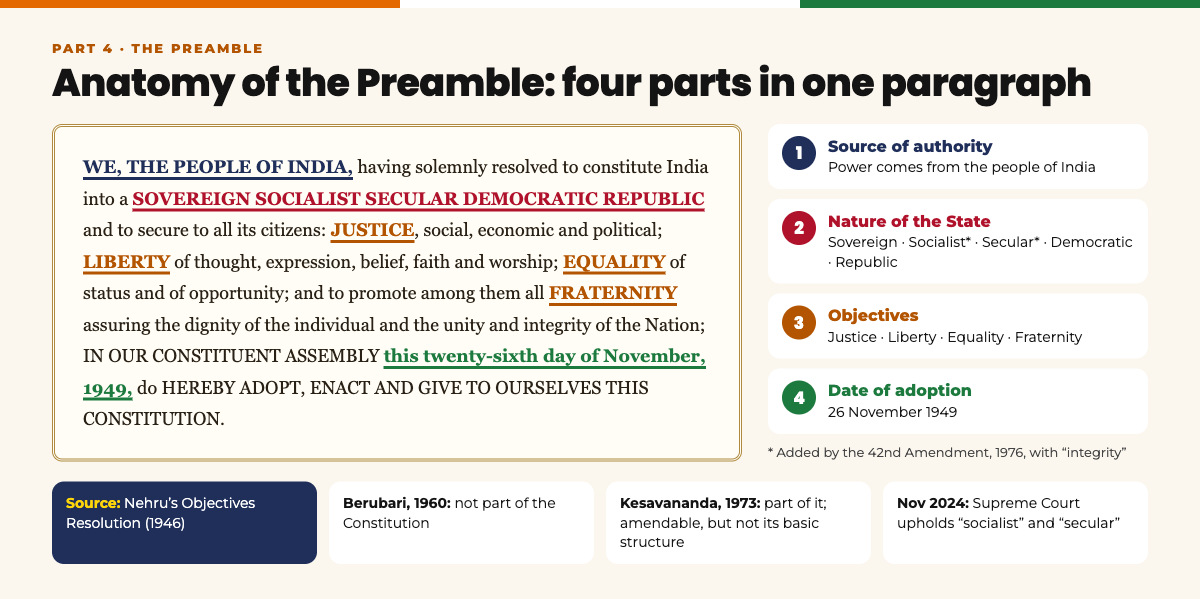
The Preamble is a single paragraph that states where the Constitution's authority comes from, what kind of state India is, and what it promises its citizens.
The text
WE, THE PEOPLE OF INDIA, having solemnly resolved to constitute India into a SOVEREIGN SOCIALIST SECULAR DEMOCRATIC REPUBLIC and to secure to all its citizens:
JUSTICE, social, economic and political;
LIBERTY of thought, expression, belief, faith and worship;
EQUALITY of status and of opportunity; and to promote among them all
FRATERNITY assuring the dignity of the individual and the unity and integrity of the Nation;
IN OUR CONSTITUENT ASSEMBLY this twenty-sixth day of November, 1949, do HEREBY ADOPT, ENACT AND GIVE TO OURSELVES THIS CONSTITUTION.
Its four parts
- Source of authority: "We, the people of India." Power flows from the citizens, not from a ruler or a foreign parliament.
- Nature of the Indian state: sovereign, socialist, secular, democratic and republican.
- Objectives: justice, liberty, equality and fraternity.
- Date of adoption: 26 November 1949.
Key words explained
Word | Meaning |
|---|---|
Sovereign | India decides its own internal and external affairs; no outside power has authority over it. |
Socialist | Democratic socialism: a mixed economy that aims to end poverty, inequality and exploitation. Added in 1976. |
Secular | The State has no religion of its own and treats all religions with equal respect. Added in 1976. |
Democratic | Power rests with the people, who elect their governments through universal adult franchise. |
Republic | The head of state, the President, is elected and not hereditary. |
Justice | Social, economic and political fairness for every citizen. |
Liberty | Freedom of thought, expression, belief, faith and worship. |
Equality | No special privileges for any group; equal status and opportunity for all. |
Fraternity | A sense of brotherhood that protects each person's dignity and the nation's unity and integrity ("integrity" was added in 1976). |
Where the Preamble came from
The Preamble is based on the Objectives Resolution moved by Nehru on 13 December 1946 and adopted on 22 January 1947. Dr. Ambedkar's drafting added a strong emphasis on fraternity and individual dignity. The ideals of liberty, equality and fraternity echo the French Revolution, and the ideal of social, economic and political justice is often traced to the Russian Revolution.
The only amendment, and the 2024 verdict
The original Preamble of 1949 did not contain the words "socialist" and "secular". The 42nd Amendment Act, 1976, added "socialist", "secular" and "integrity". This remains the only amendment to the Preamble.
In November 2024, the Supreme Court dismissed petitions challenging these additions. It explained that "secular" means a republic that gives equal respect to all religions, and "socialist" means a republic committed to ending all forms of exploitation, whether social, political or economic.
Is the Preamble part of the Constitution?
Case | Year | What the Supreme Court held |
|---|---|---|
Berubari Union | 1960 | The Preamble is not part of the Constitution, though it is a key to its meaning |
Kesavananda Bharati | 1973 | The Preamble is part of the Constitution; it can be amended, but not in a way that destroys the basic structure |
LIC of India | 1995 | Reaffirmed that the Preamble is an integral part of the Constitution |
The Preamble is not enforceable in court on its own. It is neither a source of power for the legislature nor a limit on it, but courts use it to interpret the Constitution when a provision is unclear.
Jurist N.A. Palkhivala called the Preamble the "identity card" of the Constitution.
Part 5: What makes the Constitution unique
India's Constitution combines ideas from many countries with features designed for India's size, diversity and history.
16 salient features
- The lengthiest written constitution in the world. It covers the Centre, the states, services, elections, languages and much more in detail.
- Drawn from many sources. It borrowed from dozens of constitutions and from the Government of India Act, 1935.
- Both rigid and flexible. Some provisions can be changed by a simple majority in Parliament; others need a special majority and the approval of half the states.
- Federal, with a unitary bias. Power is divided between the Centre and the states, but the Centre is stronger: there is one constitution, single citizenship, an integrated judiciary and emergency powers. It is often called "quasi-federal".
- Parliamentary form of government. Taken from the British model, the executive is answerable to the Lok Sabha.
- A balance of parliamentary sovereignty and judicial supremacy. Parliament makes laws and amends the Constitution; courts can review both.
- An integrated and independent judiciary. A single system with the Supreme Court at the top, protected from political control.
- Fundamental Rights in Part III, enforceable in court.
- Directive Principles of State Policy in Part IV, the goals of a welfare state.
- Fundamental Duties in Part IVA, added in 1976.
- A secular state. The State has no official religion and treats all faiths with equal respect.
- Universal adult franchise. Every citizen aged 18 or above can vote, without any test of property, education or gender. The voting age was 21 until the 61st Amendment of 1989.
- Single citizenship. There is one Indian citizenship, with no separate citizenship of a state.
- Independent constitutional bodies. The Election Commission, the Comptroller and Auditor General, the Union Public Service Commission and the State Public Service Commissions.
- Emergency provisions. National emergency (Article 352), President's Rule in a state (Article 356) and financial emergency (Article 360).
- Three tiers of government. The 73rd and 74th Amendments of 1992 gave constitutional status to panchayats and municipalities.
Borrowed from the world, adapted for India
Source | Features taken |
|---|---|
Government of India Act, 1935 | Federal scheme, office of Governor, judiciary, Public Service Commissions, emergency provisions, administrative details |
United Kingdom | Parliamentary government, rule of law, legislative procedure, single citizenship, cabinet system, prerogative writs, bicameralism |
United States | Fundamental Rights, judicial review, independence of the judiciary, impeachment of the President, removal of Supreme Court and High Court judges, the office of Vice-President |
Ireland | Directive Principles, nomination of members to the Rajya Sabha, method of electing the President |
Canada | Federation with a strong Centre, residuary powers with the Centre, appointment of state Governors by the Centre, advisory jurisdiction of the Supreme Court |
Australia | Concurrent List, freedom of trade and commerce, joint sitting of the two Houses of Parliament |
Erstwhile USSR | Fundamental Duties, the ideal of social, economic and political justice in the Preamble |
France | Republic; the ideals of liberty, equality and fraternity |
Weimar Germany | Suspension of Fundamental Rights during an emergency |
South Africa | Procedure for amending the Constitution, election of Rajya Sabha members |
Japan | "Procedure established by law" in Article 21 |
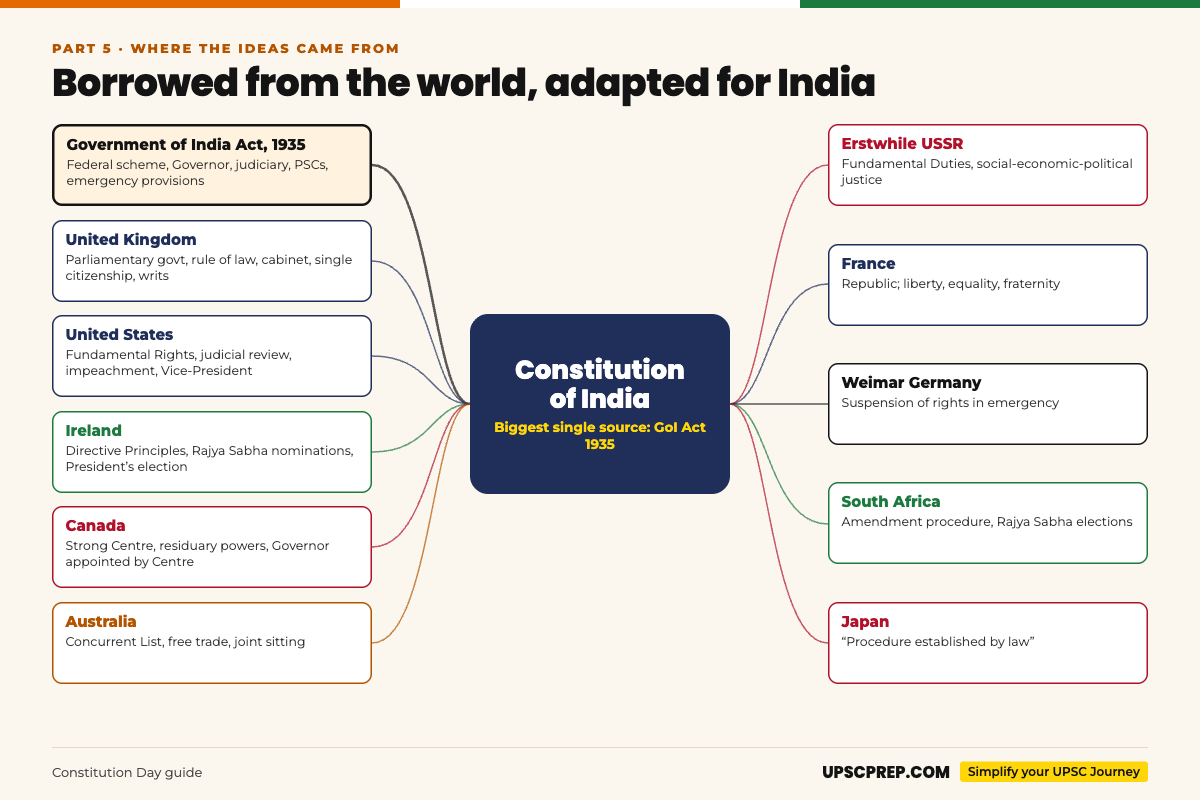
The Government of India Act, 1935 was the largest single source: much of the Constitution's structure and administrative detail comes from it. Foreign constitutions mostly supplied the philosophy.
Critics called the Constitution a "bag of borrowings". Ambedkar answered that there was nothing to be ashamed of in borrowing, since the basic ideas of a constitution were by then well known, and that the framers had adapted every borrowed idea to Indian conditions and removed its faults.
Part 6: Rights, duties and the structure of the Constitution
The Constitution protects citizens through Fundamental Rights, guides governments through Directive Principles, and reminds citizens of their own role through Fundamental Duties.
The six Fundamental Rights (Part III)
Right | Articles | What it covers |
|---|---|---|
Right to Equality | 14–18 | Equality before law and equal protection of laws; no discrimination on grounds of religion, race, caste, sex or place of birth (Art 15); equal opportunity in public jobs; abolition of untouchability (Art 17); abolition of titles |
Right to Freedom | 19–22 | Six freedoms under Art 19 (speech and expression, assembly, association, movement, residence, profession); protection in respect of conviction; protection of life and personal liberty (Art 21); right to education for children aged 6–14 (Art 21A); protection against arbitrary arrest and detention (Art 22) |
Right against Exploitation | 23–24 | Ban on human trafficking and forced labour; ban on child labour in factories, mines and hazardous work |
Right to Freedom of Religion | 25–28 | Freedom of conscience and the right to profess, practise and propagate religion; freedom to manage religious affairs |
Cultural and Educational Rights | 29–30 | Protection of the language, script and culture of minorities; their right to set up and run educational institutions |
Right to Constitutional Remedies | 32 | The right to go directly to the Supreme Court to enforce Fundamental Rights through writs: habeas corpus, mandamus, prohibition, certiorari and quo warranto |
Dr. Ambedkar called Article 32 "the very soul of the Constitution and the very heart of it".
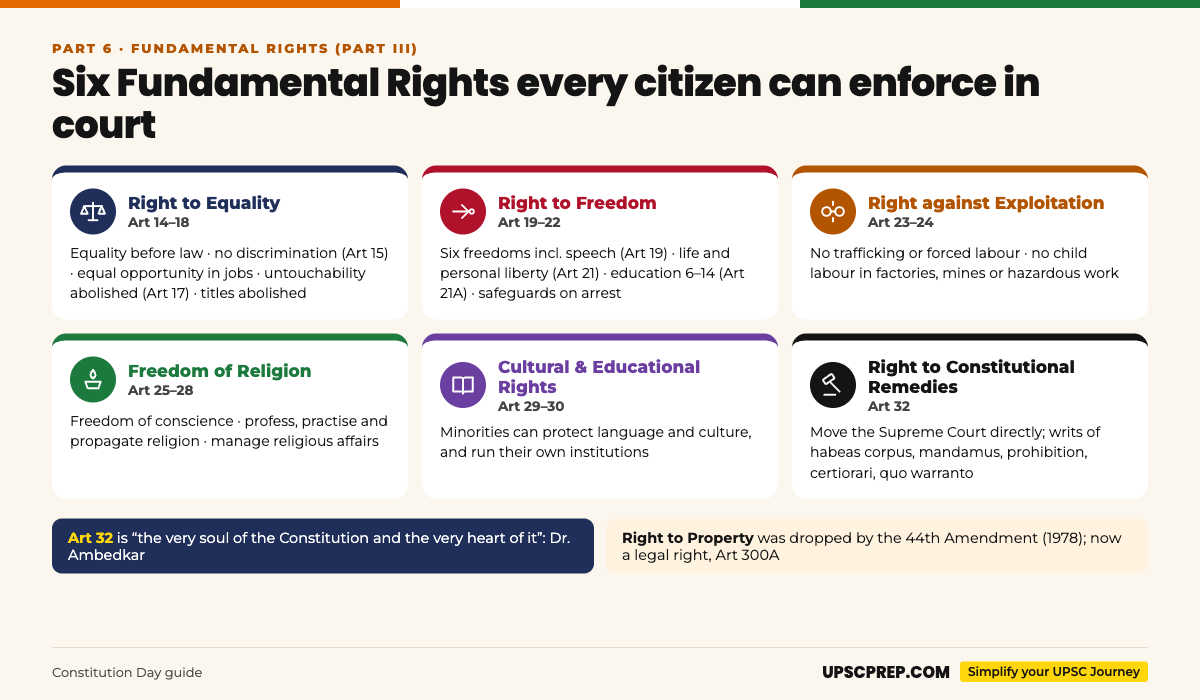
The Right to Property was originally a Fundamental Right. The 44th Amendment Act, 1978 removed it from Part III. It is now a constitutional (legal) right under Article 300A.
Directive Principles of State Policy (Part IV)
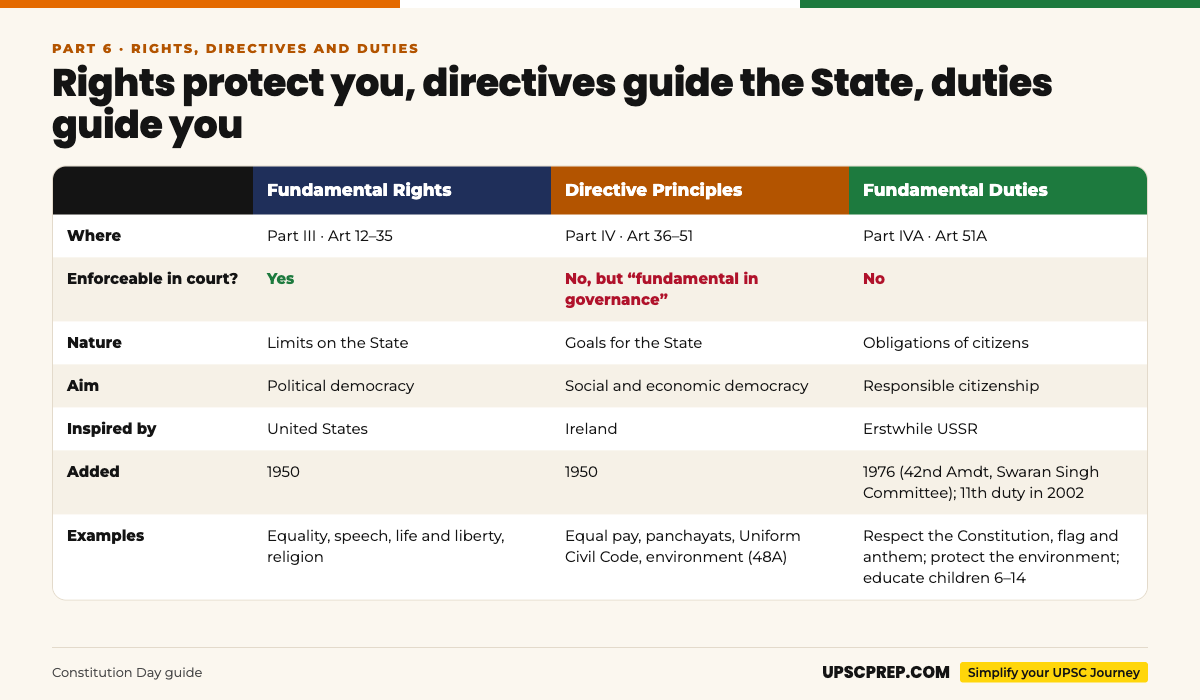
The Directive Principles (Articles 36–51) are guidelines for the Centre and the states when they make laws and policies. Courts cannot enforce them, but the Constitution calls them "fundamental in the governance of the country". They are usually grouped into three kinds:
- Socialist principles: adequate means of livelihood, equal pay for equal work, fair distribution of wealth, just and humane conditions of work, raising nutrition and public health (Articles 38, 39, 41, 42, 43, 47).
- Gandhian principles: organising village panchayats (40), promoting cottage industries (43), prohibition of intoxicating drinks (47), protecting cattle (48), and promoting the interests of Scheduled Castes, Scheduled Tribes and weaker sections (46).
- Liberal-intellectual principles: a Uniform Civil Code (44), early childhood care and education (45), modern agriculture (48), protecting the environment (48A), protecting monuments (49), separating the judiciary from the executive (50), and promoting international peace (51).
Fundamental Duties (Part IVA)
Fundamental Duties were added by the 42nd Amendment Act, 1976, on the recommendation of the Swaran Singh Committee. The idea was inspired by the Constitution of the erstwhile USSR. There were 10 duties at first; the 86th Amendment Act, 2002 added an 11th, so there are 11 duties today under Article 51A. They include duties to:
- abide by the Constitution and respect its ideals, the National Flag and the National Anthem
- cherish the ideals of the freedom struggle
- uphold the sovereignty, unity and integrity of India, and defend the country
- promote harmony and renounce practices that insult the dignity of women
- protect the natural environment and value India's composite culture
- develop a scientific temper and a spirit of inquiry
- safeguard public property and abjure violence
- strive for excellence in every sphere
- as a parent or guardian, provide opportunities for education to a child aged 6 to 14 (the 11th duty, added in 2002)
Rights, directives and duties compared
Fundamental Rights | Directive Principles | Fundamental Duties | |
|---|---|---|---|
Where | Part III (Art 12–35) | Part IV (Art 36–51) | Part IVA (Art 51A) |
Enforceable in court? | Yes | No | No |
Nature | Limits on the State | Goals for the State | Obligations of citizens |
Aim | Political democracy | Social and economic democracy | Responsible citizenship |
Inspired by | United States | Ireland | Erstwhile USSR |
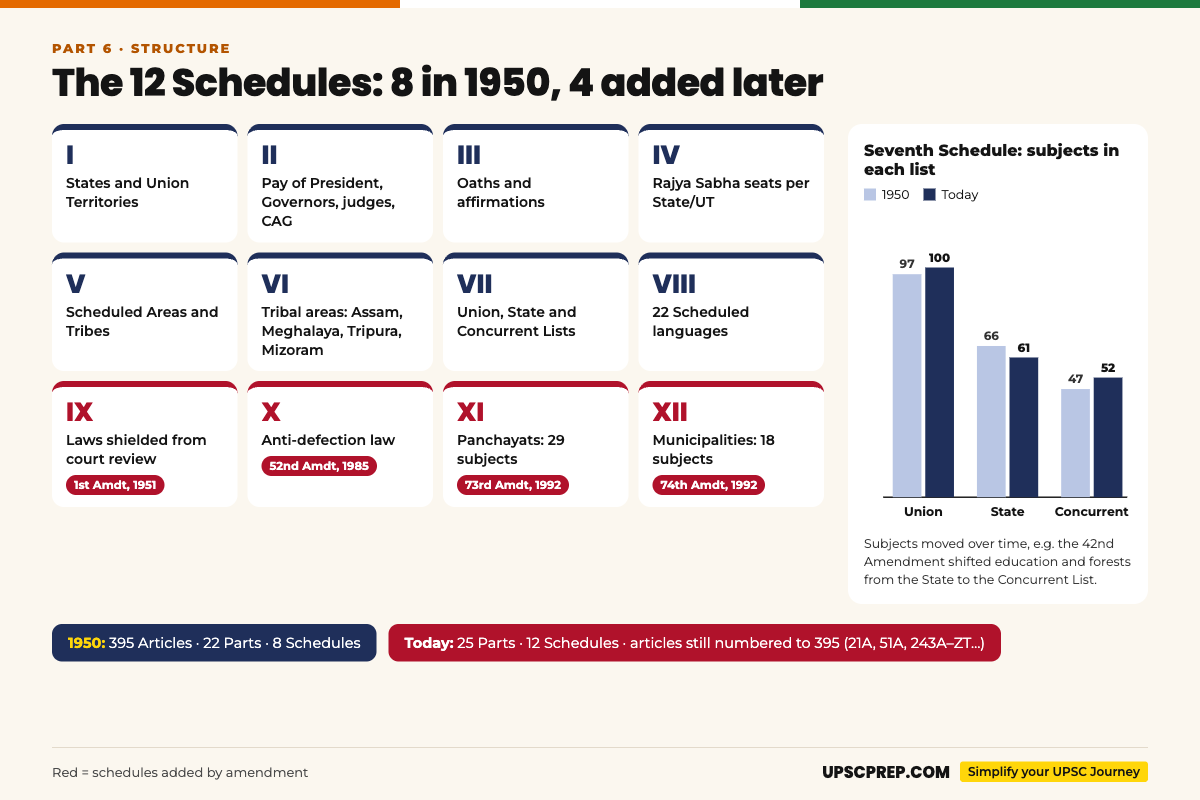
Structure: then and now
In 1950 | Today | |
|---|---|---|
Parts | 22 | 25 |
Schedules | 8 | 12 |
Articles | 395 | Still numbered up to 395, with many new articles inserted using letters (21A, 51A, 243A to 243ZT and others) |
The 12 Schedules
Schedule | Subject |
|---|---|
First | Names of the States and Union Territories and their territories |
Second | Salaries and allowances of the President, Governors, Speakers, judges, the CAG and others |
Third | Forms of oaths and affirmations |
Fourth | Allocation of Rajya Sabha seats to States and Union Territories |
Fifth | Administration and control of Scheduled Areas and Scheduled Tribes |
Sixth | Administration of tribal areas in Assam, Meghalaya, Tripura and Mizoram |
Seventh | Division of powers: the Union List, State List and Concurrent List |
Eighth | The 22 languages recognised by the Constitution |
Ninth | Laws protected from judicial review (added by the 1st Amendment, 1951) |
Tenth | Anti-defection law (added by the 52nd Amendment, 1985) |
Eleventh | Powers of panchayats: 29 subjects (added by the 73rd Amendment, 1992) |
Twelfth | Powers of municipalities: 18 subjects (added by the 74th Amendment, 1992) |
In the I.R. Coelho case (2007), the Supreme Court held that laws placed in the Ninth Schedule after 24 April 1973 (the date of the Kesavananda Bharati judgment) can still be reviewed by courts if they violate the basic structure.
Part 7: Amendments, the basic structure and key facts
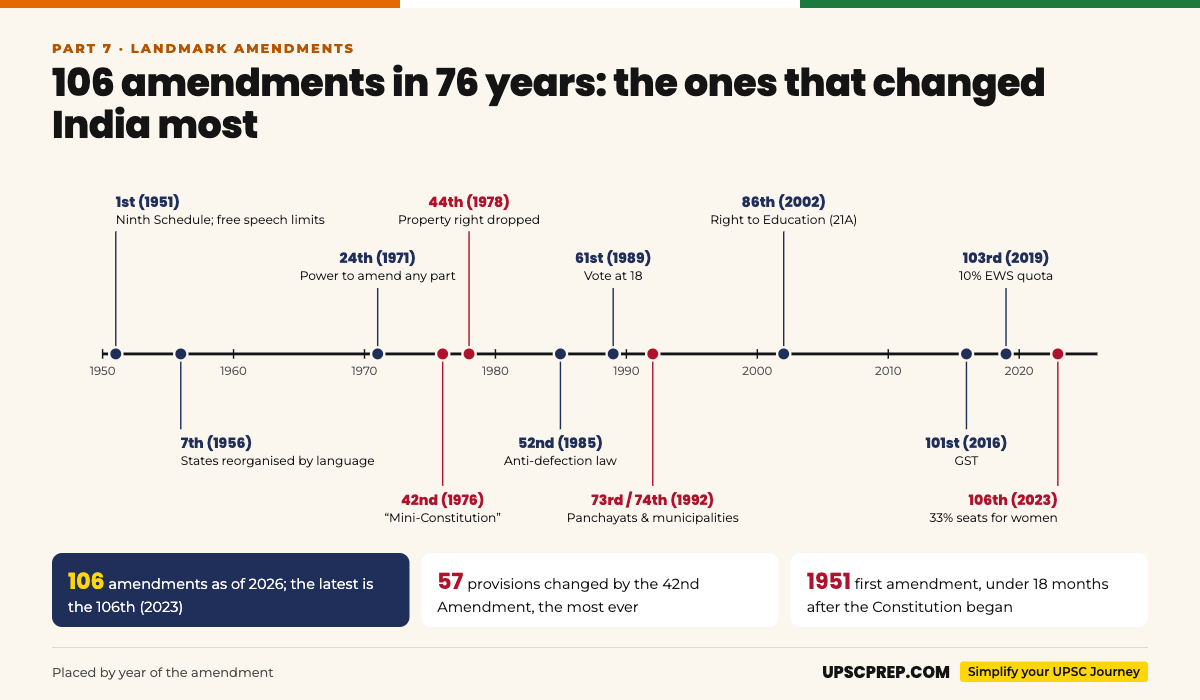
The Constitution has been amended 106 times since 1950; the latest is the 106th Amendment Act, 2023, which reserves one-third of seats for women in the Lok Sabha and state assemblies. It can grow with the times, but its core is protected.
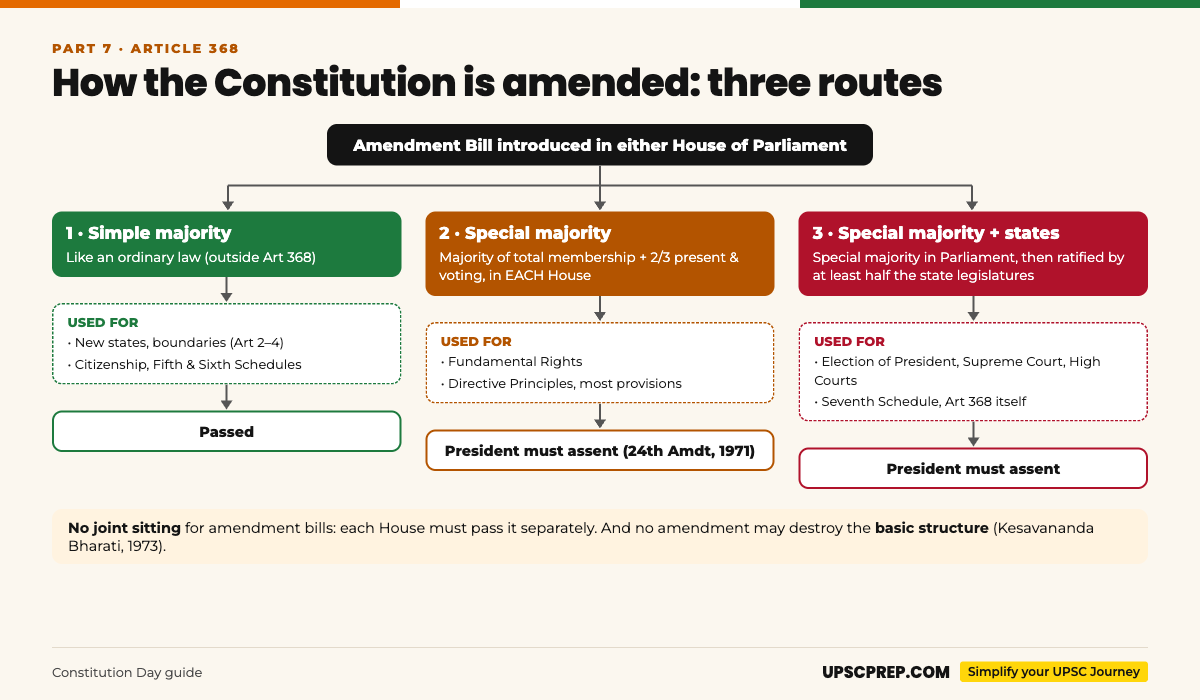
How the Constitution is amended (Article 368)
The Constitution can be changed in three ways, depending on what is being changed:
- Simple majority of Parliament. Used for provisions such as forming new states or changing state boundaries (Articles 2–4), citizenship, and the Fifth and Sixth Schedules. These changes are technically outside Article 368.
- Special majority of Parliament. A majority of the total membership of each House, plus two-thirds of the members present and voting. Used for most provisions, including Fundamental Rights and Directive Principles.
- Special majority plus ratification by half the states. Used for provisions that affect the federal structure: the election of the President, the Supreme Court and High Courts, the distribution of powers (Seventh Schedule), representation of states in Parliament, and Article 368 itself.
An amendment bill can be introduced in either House. There is no joint sitting if the two Houses disagree, and the President must give assent (made compulsory by the 24th Amendment, 1971).
Landmark amendments
Amendment | Year | What it did |
|---|---|---|
1st | 1951 | Added the Ninth Schedule to protect land reform laws; allowed reasonable restrictions on free speech |
7th | 1956 | Reorganised states on linguistic lines |
24th | 1971 | Affirmed Parliament's power to amend any part of the Constitution, including Fundamental Rights |
42nd | 1976 | The "mini-constitution": added socialist, secular and integrity to the Preamble, added Fundamental Duties, and changed 57 provisions, the most by any amendment |
44th | 1978 | Removed the right to property from Fundamental Rights; restored safeguards weakened during the Emergency |
52nd | 1985 | Anti-defection law (Tenth Schedule) |
61st | 1989 | Lowered the voting age from 21 to 18 |
73rd and 74th | 1992 | Constitutional status for panchayats and municipalities |
86th | 2002 | Right to education for children aged 6–14 (Article 21A) |
101st | 2016 | Goods and Services Tax (GST) |
103rd | 2019 | 10% reservation for economically weaker sections |
106th | 2023 | One-third of seats reserved for women (Nari Shakti Vandan Adhiniyam) |
The basic structure doctrine
In Kesavananda Bharati v. State of Kerala (1973), a 13-judge bench of the Supreme Court, the largest ever, ruled by 7 to 6 that Parliament can amend any part of the Constitution but cannot destroy its basic structure.
The Court has not given a closed list, but features held to be part of the basic structure include:
- supremacy of the Constitution
- the sovereign, democratic and republican nature of the state
- secularism
- federalism
- separation of powers
- judicial review
- the rule of law
- free and fair elections
- independence of the judiciary
- the welfare state and the dignity of the individual
Later cases applied the doctrine. In Indira Gandhi v. Raj Narain (1975), the Court struck down part of the 39th Amendment. In Minerva Mills (1980), it held that limited amending power and the balance between Fundamental Rights and Directive Principles are themselves part of the basic structure.
Key facts worth knowing
- The original handwritten copies, in Hindi and English, are kept in special helium-filled cases in the Library of Parliament.
- 284 members signed the Constitution on 24 January 1950.
- The English original was hand-written by Prem Behari Narain Raizada, and every page was decorated by artists from Santiniketan.
- The Constitution was adopted with 395 Articles, 22 Parts and 8 Schedules.
- The 42nd Amendment changed 57 provisions, more than any other amendment.
Ambedkar's warning
In his final speech to the Constituent Assembly on 25 November 1949, Dr. Ambedkar said:
"However good a Constitution may be, if those who are implementing it are not good, it will prove to be bad. However bad a Constitution may be, if those implementing it are good, it will prove to be good."
He also warned that political democracy cannot last unless it rests on social democracy, which he described as a way of life that recognises liberty, equality and fraternity as one inseparable trinity.
UPSC corner
Quick revision: facts often asked in Prelims
Question | Answer |
|---|---|
Who first proposed a Constituent Assembly? | M.N. Roy, 1934 |
First meeting of the Constituent Assembly | 9 December 1946 |
Temporary chairman | Dr. Sachchidananda Sinha |
Permanent President | Dr. Rajendra Prasad |
Objectives Resolution moved / adopted | 13 December 1946 / 22 January 1947 |
Drafting Committee set up / chaired by | 29 August 1947 / Dr. B.R. Ambedkar |
Constitutional Advisor | Sir B.N. Rau |
Constitution adopted | 26 November 1949 |
Constitution came into force | 26 January 1950 |
Time taken | 2 years, 11 months, 18 days |
Original size | 395 Articles, 22 Parts, 8 Schedules |
Women members | 15 |
Constitution Day first observed | 2015 (earlier National Law Day, from 1979) |
Only amendment to the Preamble | 42nd Amendment, 1976 |
Fundamental Duties | Article 51A; added 1976 (Swaran Singh Committee); 11 today |
Total amendments | 106 (latest: 106th, 2023) |
Basic structure doctrine | Kesavananda Bharati, 1973 (13 judges, 7:6) |
Prelims practice MCQs
Mains practice questions
- "The Indian Constitution is a living document." Discuss with reference to constitutional amendments and the basic structure doctrine. (250 words)
- The Constituent Assembly was not directly elected, yet it is said to have represented the will of the Indian people. Examine. (150 words)
- Fundamental Rights and Directive Principles are complementary, not conflicting. Discuss with the help of judicial pronouncements. (250 words)
- Discuss the significance of the Preamble in interpreting the Constitution. Is it a part of the Constitution? (150 words)
Conclusion
The Constitution of India turned the goals of the freedom struggle into a working system of government. Seventy-six years after its adoption, it has been amended 106 times, yet its core values of justice, liberty, equality and fraternity remain unchanged. Constitution Day is a reminder that those values depend not only on the text, but on the citizens and institutions who live by it.
Sources
- Press Information Bureau: Constitution Day, 2026 to be observed on 26th November (25 November 2026)
- The Hindu: Why is November 26 celebrated as Constitution Day in India (26 November 2026)
- constitutionofindia.net: Assessing constitutional amendments