
Topic: World History
Q1. The Russian revolution of 1917 overthrew the system of autocracy in Russia. What were the causes of the Russian revolution? How far are the ideals of the Russian Revolution significant in the modern world? (15 Marks)
Model Structure
Introduction:
- The Russian Revolution was a period of political and social revolution that took place in the former Russian Empire which began during the First World War.
Main body:
The Russian Revolution of 1917 was actually two revolutions. The first revolution in February overthrew the imperial government. The second revolution in October placed the Bolsheviks in power.
Causes of the Russian Revolution
- Political:
- In the 19th century, entire Europe was undergoing important social, economic and political transformation. Most of the countries were republics like France or constitutional monarchies like England. The rule of the old feudal aristocracies had been replaced by that of the new middle classes. Russia, however, was still living in ‘the old world’ under the autocratic rule of the Czars.
- Social:
- Serfdom had been abolished in 1861, but it did not improve the condition of peasants. They still had miserably small holdings of land with no capital to develop even these.
- For the small holdings they acquired, they had to pay heavy redemption dues for decades. Land hunger of the peasants was a major social factor in Russian society.
- The workers had no political rights and no means of gaining even minor reforms. The words of Marx that workers have ‘nothing to lose but their chains’ rang literally true to them.
- Economy:
- Industrialisation began very late in Russia, in the second half of the nineteenth century. Then it developed at a fairly fast rate, but more than half of the capital for investment came from foreign countries. Foreign investors were interested in quick profits and showed no concern for the conditions of workers. Russian capitalists, with insufficient capital, competed with foreign investors by reducing workers’ wages. Whether factories were owned by foreigners or Russians, the conditions of work were horrible.
Significance:
- The Czarist empire was transformed into a new state called the Union of Soviet Socialist Republics (U.S.S.R). The policies of the new state were to be directed to the realisation of the old socialist ideal, ‘from each according to his capacity, to each according to his work’.
- Private property in the means of production was abolished and the motive of private profit was eliminated from the system of production.
- Economic planning by the state was adopted to build a technologically advanced economy at a fast rate and to eliminate glaring inequalities in society.
- The right to work became a constitutional right and it became the duty of the state to provide employment to every individual. Education of the entire people was given a high priority. The equality of all nationalities in the U S S.R. was recognised in the constitution framed in 1924 and later in 1936.
- The constitution gave the republics formed by the nationalities autonomy to develop their languages and cultures.
- These developments were particularly significant for the Asian republics of the U.S.S.R., which were much more backward than the European part.
In its impact on the world, the Russian Revolution had few parallels in history. The ideas of socialism which the socialist movement had been advocating and which the Russian Revolution espoused, were intended for universal application. The Russian Revolution was the first successful revolution in history, which proclaimed the building of a socialist society as its objective. It led to the creation of a new state over a vast area of the globe.
Conclusion
- Writing about the Russian Revolution in his Autobiography, Jawaharlal Nehru said, “It made me think of politics much more in terms of social change.”
Q2. The disruptive character of the Industrial Revolution in Europe was not limited to the economy but extended to social aspects as well. Comment. (15 marks)
Model Structure
Introduction:
- The Industrial Revolution refers to the rapid period of economic and social change that began in Britain around 1760, aided by technological innovations such as steam engines, power looms, etc.
- It marked a period of development in the latter half of the 18th century that transformed largely rural, agrarian societies in Europe into industrialised, urban ones.
Main Body:
The disruptive changes brought by Industrial Revolution in Europe’s economy:
- Shift in the mode of production: Europe experienced a shift from a traditional, labour-intensive economy to a more capital-intensive economy based on manufacturing by machines, specialised labour, and industrial factories.
- Rise of industry’s share in the national output: Extraction of surplus output through full exploitation of labour and technological improvements increased the share of industry in the economy of Europe.
- Growth of new cities: Workers who once were employed among scores of small farms in the countryside were now shifted to places near the factories where they were employed.
- This resulted in the emergence of new economic cities in Great Britain, France, Belgium, etc.
- Rising economic inequalities: Though the wages of workers increased as a result of more profits, still the majority was accrued to the capitalist class leading to huge inequalities.
The disruptive changes were not just confined to the economic sphere but also extended to social aspects:
- Capitalist and worker’s segregation: It led to the creation of a wealthy industrial middle class on one hand and a huge industrial working class on the other.
- Poor condition of workers: They had to work continuously for long hours, under strict discipline and were subjected to sharp forms of punishment.
- Further, the machinery was very unsafe, and there was no compensation even for life-threatening injuries.
- Changing social profile: Women and children started working in factories to supplement the meagre wages of men.
- They were exploited and employed in dangerous tasks with meagre wages.
- Urban living conditions: The development of large factories encouraged the mass movement of people from the countryside to urban areas with no substantial improvements in housing, sanitation, etc., leading to the proliferation of slums.
- One of the more important consequences of this urbanisation was a rapid increase in crime.
- Population growth: Shifting away from the earlier challenges like famines, epidemics and war, the post-industrial revolution ensured adequate food and low intensity of plague, which led to a decline in the death rate and a rapid increase in population.
Conclusion
- Ultimately, the industrial revolution led to increased contact between countries, which resulted in imperialism whereby the colonial powers tried to establish control over the colonies by use of military power, direct rule and rule by intermediaries.

Q3. Evaluate the combination of long-term structural factors and immediate events that contributed to the outbreak of the French Revolution in 1789. (10 Marks)
Introduction
- The French Revolution was the watershed event in modern European history that brought about enlightenment principles and democracy, creating a rational and egalitarian society. It started in 1789 and ended in 1799. (Context-based introduction)
Main Body
Long-term structural factors that led to French Revolution
- Socioeconomic Inequality: Most of the population, including the peasantry and urban workers, faced severe economic hardships while the nobility and clergy enjoyed privileges and exemptions from taxation. The burden of taxation fell disproportionately on the lower classes, exacerbating social tensions.
- Financial Crisis: France faced a severe financial crisis due to its involvement in costly wars, extravagant court expenditures, and a regressive tax system.
- Absolutist Monarchy: France had an absolutist monarchy, where the king held ultimate power and authority.
- Intellectual – The 18th century was marked by a conscious refusal by French thinkers of the ‘Divine Rights Theory’. Philosophers like Rousseau rejected the paradigm of absolute monarchy and promulgated the doctrine of equality of man and sovereignty of people.
Immediate events that led to the outbreak of French Revolution
- Estates-General: In an attempt to resolve the financial crisis, King Louis XVI called for the convening of the Estates-General in 1789. However, the commoners, who represented most of the population, were frustrated by the privileged positions held by the first two estates, which had the power to block reforms.
- The economic hardship worsened due to poor harvests and rising food prices, leading to food shortages and increased suffering among the lower classes.
- Rumours of royal conspiracies, the dismissal of reform-minded ministers, and the deployment of troops in Paris further aggravated the public's frustration.
- The Storming of the Bastille: On July 14, 1789, Parisians stormed the Bastille, a symbol of royal authority and repression. This event, sparked by a combination of political and economic grievances, marked a turning point and led to a surge in popular uprising throughout the country.
Conclusion
- Therefore, the French Revolution that introduced the values of ‘Liberty, Equality and Fraternity’, resulted in the overthrow of the monarchy, the rise of radical political factions, societal upheaval, and the eventual spread of revolutionary ideals across Europe was a culmination of long term structural factors as well as immediate events.
Q4. Assess the influence of decolonisation on the political, social, and economic development of newly independent nations in the post-World War II era. (10 Marks)
Introduction
- Definition-based: Decolonisation refers to the process by which colonies or territories under the control of foreign powers gain independence and assert their sovereignty.
- Context-based: Post-World War II, several States got decolonised as the 2nd World War dealt a serious blow to the colonial powers, depriving them of their former prestige. The emergence of two anti-colonialist superpowers, the United States and the Soviet Union, and the new international climate after 1945 encouraged the colonies to make a bid for independence.
Main Body
After 1945, many States in Africa and Asia were decolonised. The ultimate goal of decolonisation is to end the political, economic, and cultural domination of colonised peoples by external powers, allowing them to govern themselves and shape their own destinies.
Therefore, the decolonisation of the nations in the post-World War II era had a profound influence on their political, social, and economic development.
Influence on political development
- Many of these nations adopted various forms of governance, including democracies, one-party states, or authoritarian regimes.
- There were struggles for power, ethnic tensions, frequent coups and political instability hampering progress in some cases.
- Many politicians lacked experience of working with the system of parliamentary democracy left behind by the Europeans.
- Politically, many countries have been unable to pay off this debt for decades, therefore, it still persists.
Influence on social development
- Decolonisation played a crucial role in shaping national identities and fostering a sense of self-determination among the newly independent nations.
- It allowed for the reclamation of cultural heritage, language, and traditions, as well as the pursuit of social reforms and policies aimed at addressing historical injustices, such as discrimination and inequality.
- However, the process of forging cohesive national identities and managing diverse populations also presented significant challenges, including ethnic conflicts and social divisions. For e.g. in Nigeria, the Congo (Zaire), Burundi and Rwanda, tribal differences became so intense that they led to civil wars.
Influence on economic development
- Newly independent nations sought to develop their economies, often focusing on industrialisation, agriculture, and natural resource exploitation.
- However, the legacies of colonialism, such as economic dependency, unequal distribution of resources, and underdeveloped infrastructure, posed obstacles to progress.
- Many countries faced economic difficulties, including high poverty levels, unemployment, and debt, leading to economic instability and reliance on foreign aid.
- Even though the former colonies were now legally independent, they remained largely reliant on the West for assistance in building their political and economic institutions.
- To finance their own growth, newly independent republics borrowed money from Western nations, which led to mounting debts.
Conclusion
- Decolonisation is not a finite event but an ongoing journey of unlearning, reimagining, and forging new paths towards a new future. Therefore, the influence of decolonization on the political, social, and economic development of newly independent nations in the post-World War II era is of continuing nature.
Q5. How far is it correct to say that the First World War was fought essentially for the preservation of the balance of power? (15 Marks)
Introduction
- The statement is largely correct. WWI began when the European balance of power, built after 1815, collapsed under German rise and alliance rivalry. But it was not fought only for balance; nationalism, imperialism and militarism converted the crisis into total war.
Main Body
Why balance of power was central
- Germany’s unification in 1871 disturbed Europe: a powerful industrial-military state emerged at the continent’s centre.
- Europe got divided into two armed blocs: Triple Alliance and Triple Entente. Hence, the Sarajevo assassination became a continental war.
- Britain entered partly to prevent German domination of Europe and to defend Belgian neutrality under the 1839 treaty.
- France wanted to contain Germany and recover Alsace-Lorraine; Russia wanted to check Austro-German influence in the Balkans.
- Thus, each power justified war as preventing another power from becoming hegemonic.
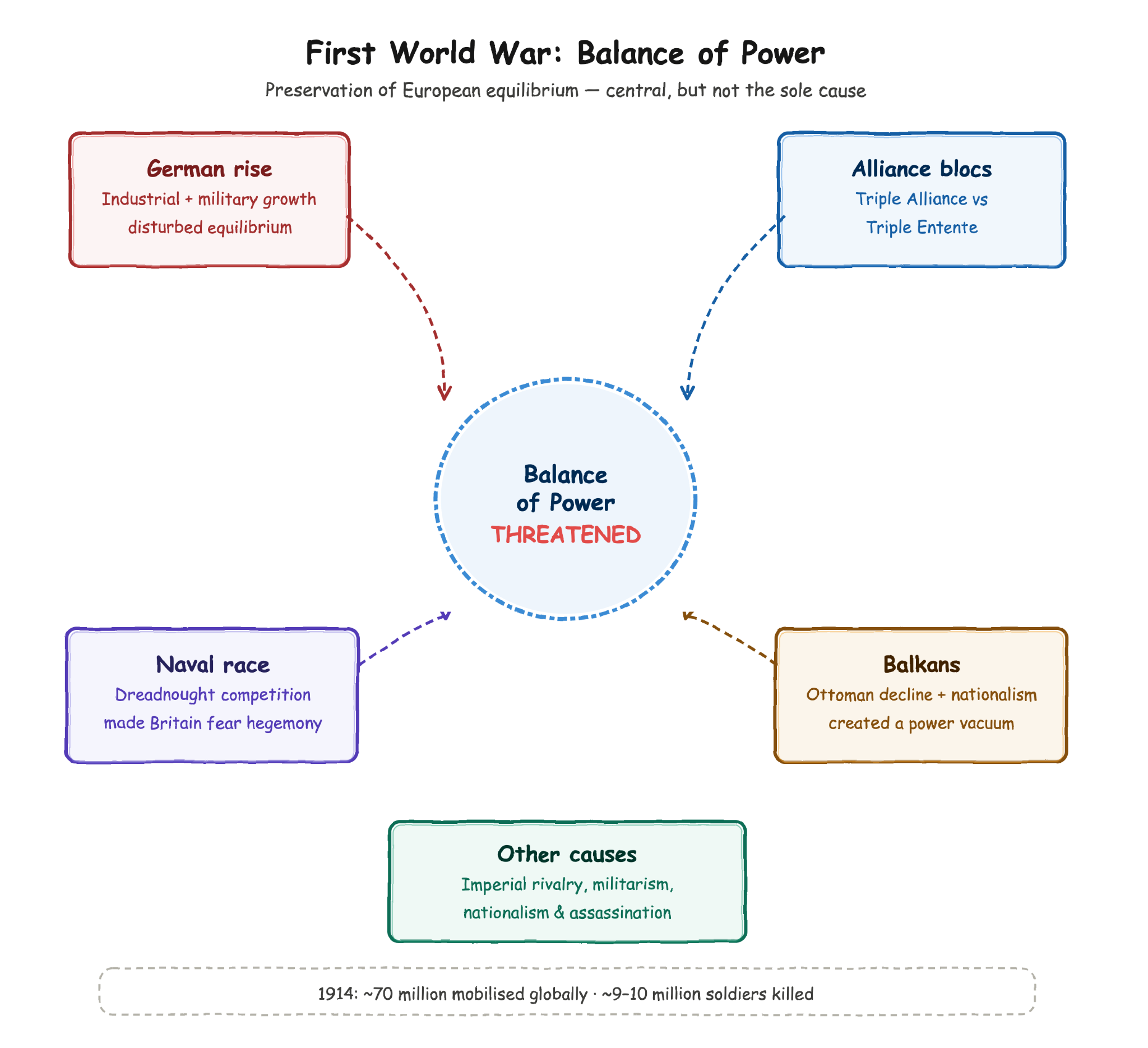
But balance of power is insufficient
- Nationalism: Serbian pan-Slavism and Balkan nationalism directly triggered the July Crisis.
- Imperialism: Morocco crises and colonial competition sharpened Anglo-German and Franco-German tensions.
- Militarism: arms race, Schlieffen Plan and railway timetables made diplomacy rigid.
- Alliance system: instead of preserving balance, alliances created automatic escalation.
- WWI mobilised about 70 million people and caused nearly 9–10 million soldier deaths, showing how a limited power crisis became total war.
Conclusion
- Therefore, WWI was substantially a balance-of-power war, especially for Britain, France and Russia. However, it was not “essentially” only that; it was a balance-of-power crisis intensified by nationalism, imperialism, militarism and alliance obligations.

Mains Focus Group 2026 with Mentorship
Comprehensive lectures to make you Mains ready in 75 Days